
Fujifilm’s powerful, fun travel cameras pass the test
Fujifilm’s travel cameras are capable of impressive results whether you are travelling the world or just wandering into your garden for a day of flower or wildlife photography.
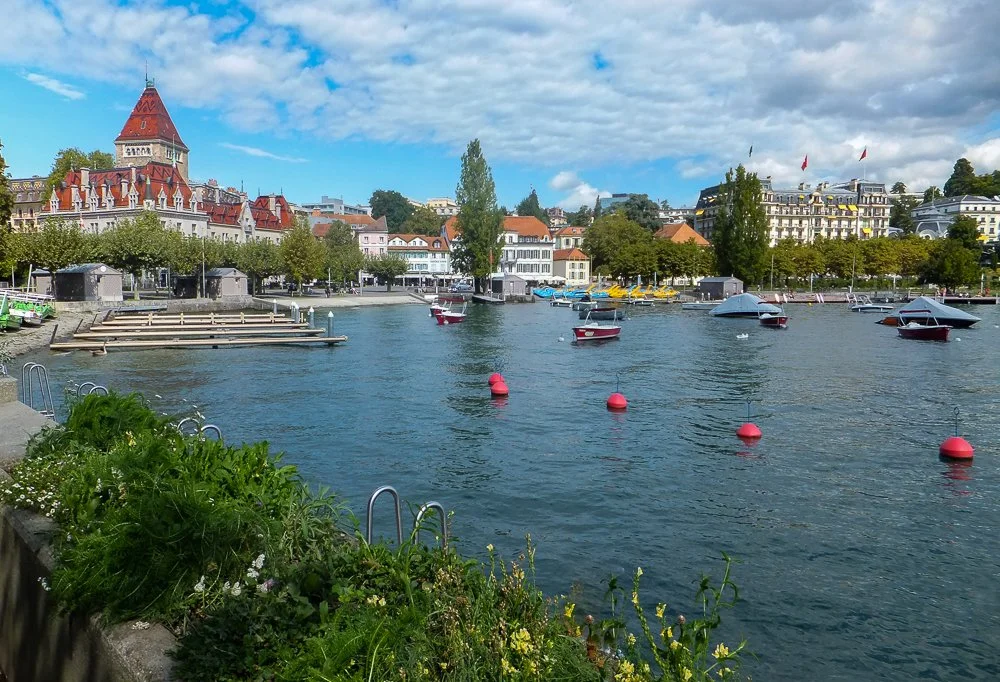
The harbour in Lausanne's Ouchy/Olympic district in Switzerland.
Fujifilm F660EXR: From thrift-store find to priceless European vacation images
It takes a special camera to find a spot in your travel pack just weeks after picking it up at a local thrift shop for less than a couple of fancy Swiss espressos.
That’s exactly what happened recently when my wife and I flew to Switzerland to board a once-in-a-lifetime Rhine River cruise. I had been trying to decide what cameras would be small enough to take everywhere I went in Europe, but also could provide the quality I wanted to ensure I would not regret the choice when I returned home with hundreds maybe even thousands of images.
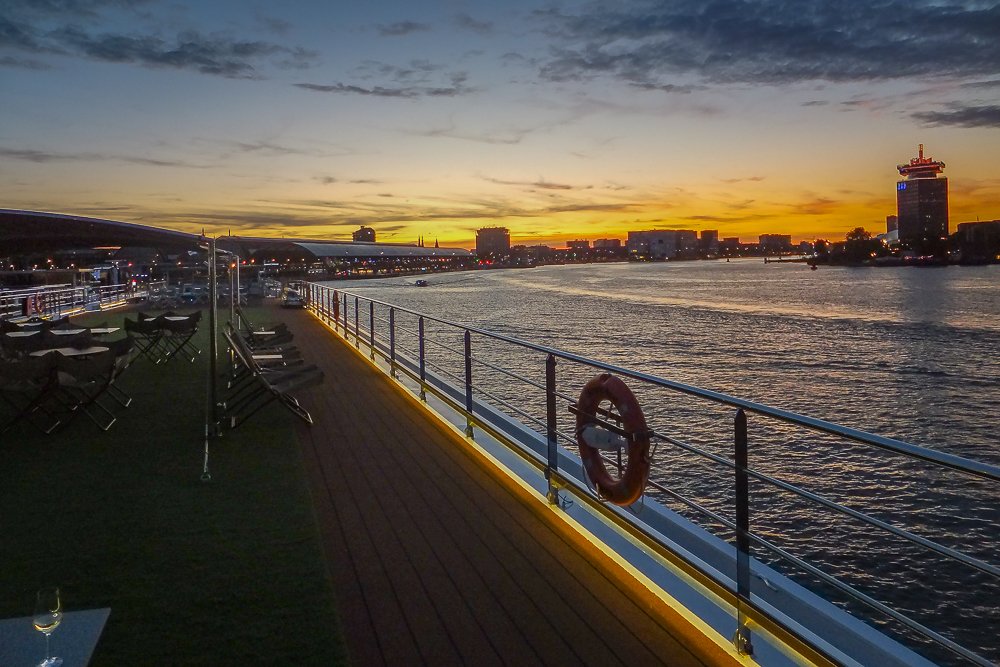
Sunset over Amsterdam from the deck of our ship taken with Fujifilm F660EXR travel camera.
The choice was the Fujifilm F660EXR travel camera from 2012 that boasts a 15X compact superzoom with a 35mm equivalent lens ranging from a very wide 24mm to a more than adequate 360mm.
This combination meant there was nothing standing in the way of capturing the incredible vistas of the Rhine River valley complete with its magnificent castles, or the details of same castles from the comfort of our deck chairs. All this capability packaged with Fuji’s EXR technology and a 1/2"-inch, 16MP CMOS sensor with a generous 3.0-inch 460,000 dot LCD viewing panel.

The Fujifilm F660EXR quick startup helped to catch this image of a woman in red walking beneath an impressive Swiss flag in the city of Lausanne.
For the beginner photographer who cares little about such details, these specs simply translate into a very capable camera.
But the impressive stats were not the only reason I chose to pack this camera rather than a host of other more capable possibilities filing my camera case.
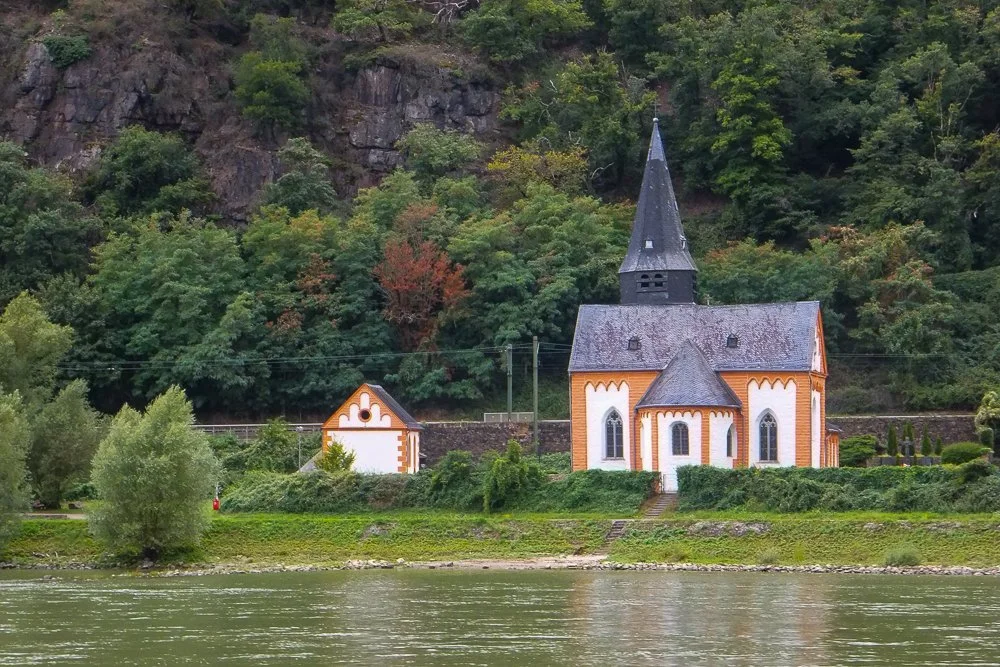
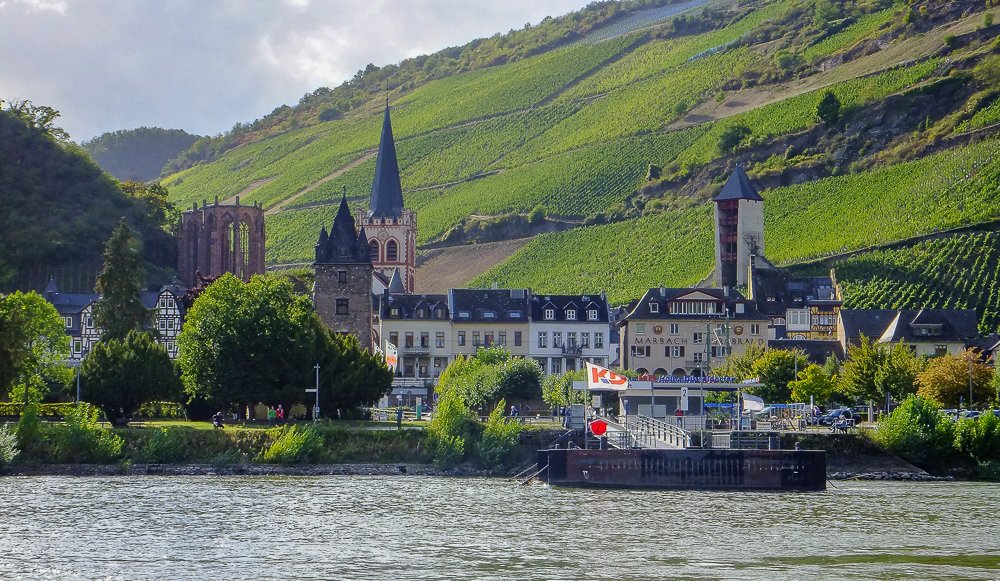
The Fujifilm F660EXR’s zoom range was able to frame this image of a church while cruising the Rhine River.
What really convinced me was the camera’s superb performance discovered in the few weeks prior to the cruise. After running the camera through its paces, I gained complete confidence that it would deliver. That, and the fun factor of using this little gem to capture the spring woodlands around our home made the decision easy.
Now, to be fair, a big part of the decision revolved around the camera’s pocketability and, once again, the Fujifilm F660EXR proved too good to be true. Fuji made this thing so streamlined that there wasn’t a pocket it didn’t like.
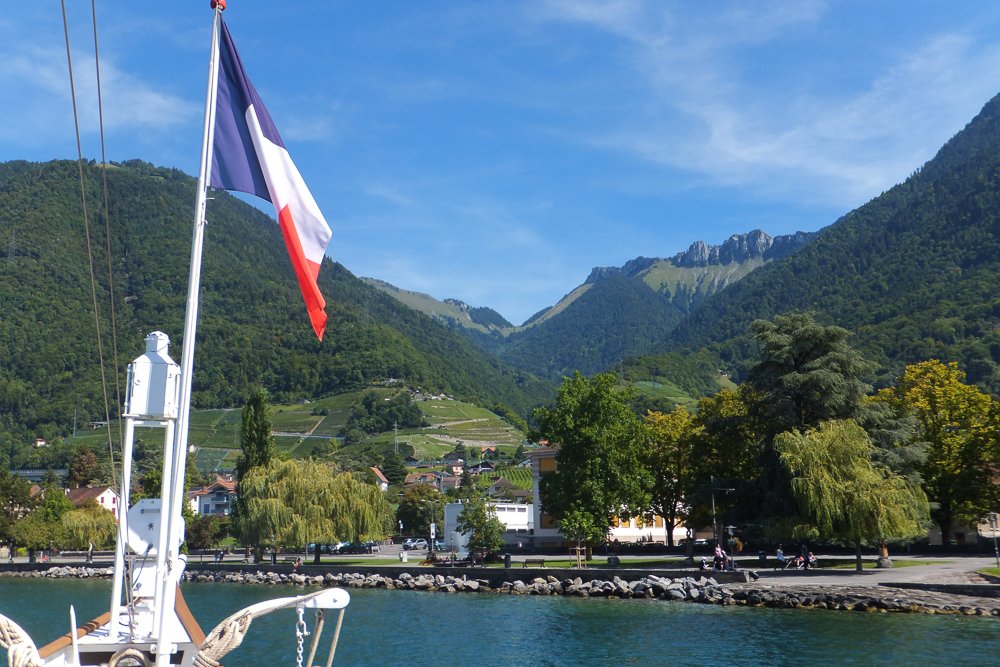
A day cruise of the beautiful Lake Geneva in Switzerland taken with the Fujifilm F660EXR.
I confess that Fuji’s magnificent little travel camera was not the only camera in my pack. The other travel companion was the miniaturized Pentax Q complete with a couple of its tiny lenses. Both cameras gave me everything I needed to capture the beauty of Switzerland and the Rhine River.
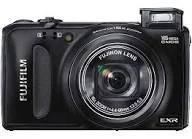
Fujifilm F660EXR
In this post, however, I am going to focus on the Fujifilm. For my separate post on the Pentax Q, click here. For my post on shooting street photography while on vacation, click here. And, for my post on capturing window box images in Europe click here.
As travel cameras go, the Fujifilm EXR F-series pack a real punch including their almost cult-like film-simulation settings including Velvia for vivid colours, Provia for a more natural look, Astia for a softer effect (excellent for portraits and people pictures) and, of couse, B&W and sepia settings.
Add to the film simulations a huge selection of picture modes for special effects or difficult exposure situations. A particularly useful addition is Fujifilm’s impressive pro-focus selection that creates an image with a soft background that can be varied depending on your preference.
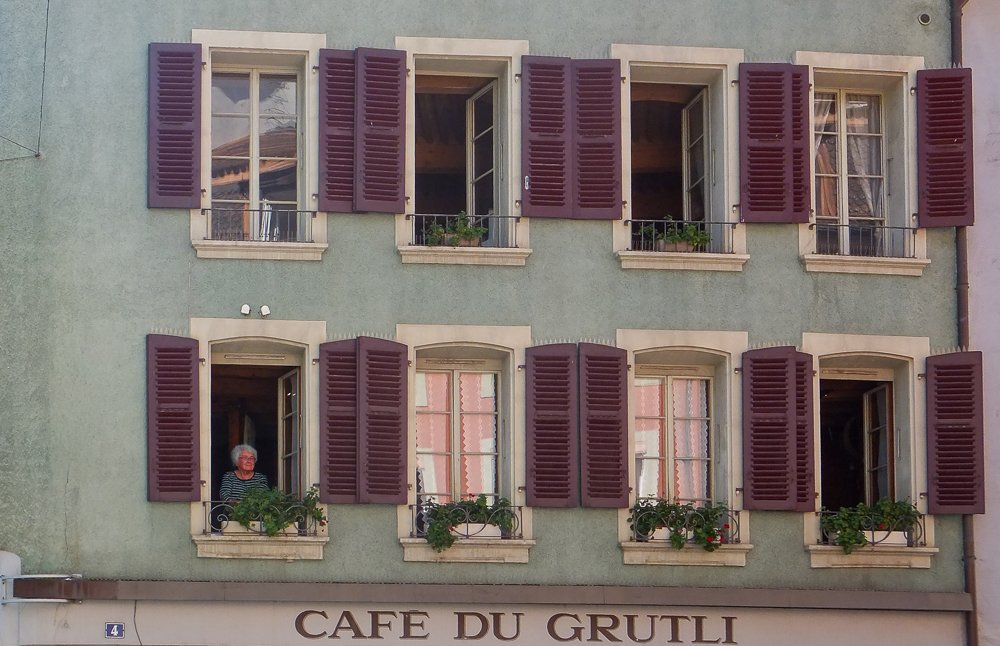
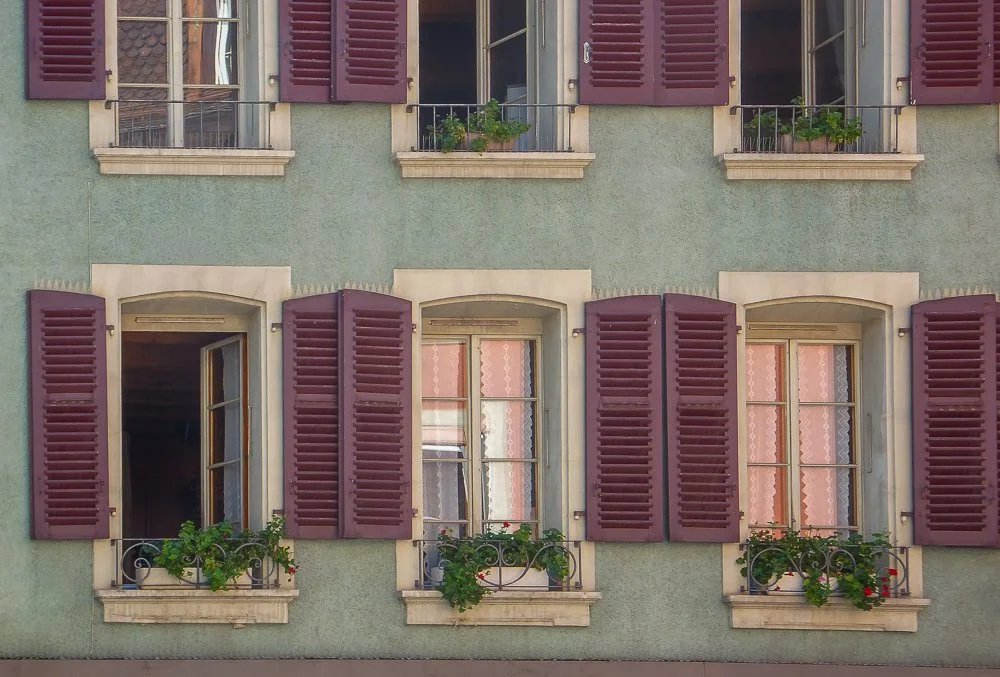
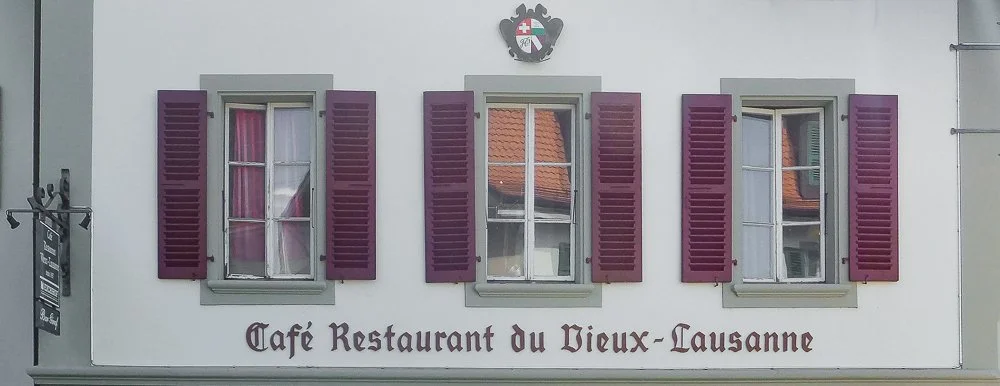
Windows onto the world captured by the Fujifilm F660EXR.
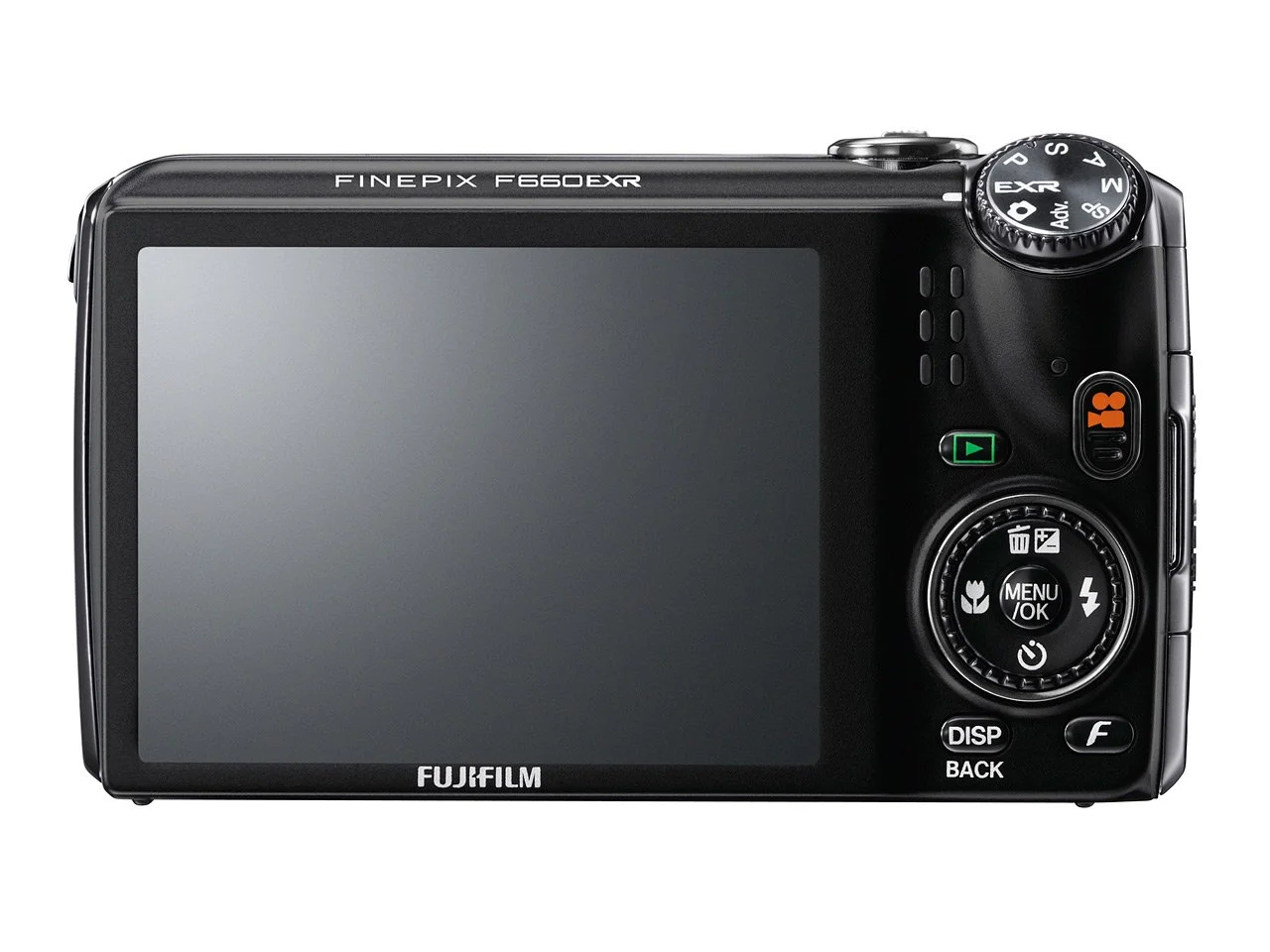
Back of the Fujifilm F660EXR
The list of features the camera includes are too numerous to list here but of note is the ability shoot in every mode imaginable from manual to aperature and shutter priority for those who want to take full control of the camera, to the EXR mode that looks at the scene and selects the best option for the finest results. Unlike a typical “program” mode – the Fujifilm has this mode as well – the EXR uses the camera’s most advanced abilities to ensure high-quality images even in the worst or most difficult lighting conditions often involving taking a series of images and then incorporating them into a single, high-resolution image.
The above images and the following ones are just a few of the images taken on the European vacation. For more images taken on with the Fujifilm F660EXR film camera – including some of my favourite images not taken on the vactation, watch for my photo gallery which will be appearing here at a later date.
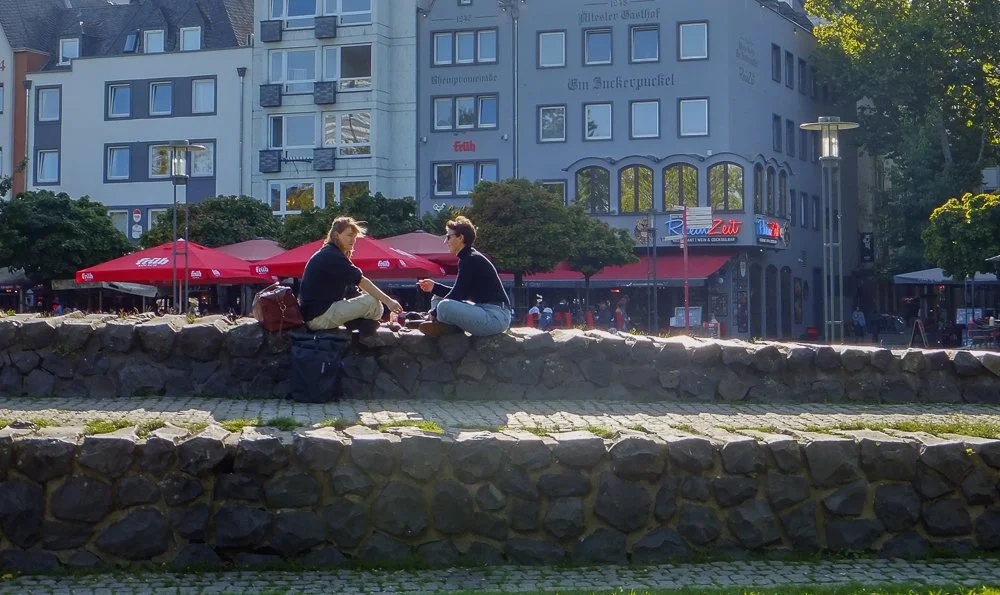
The long focal length of the Fujifilm allowed me to capture these two talking from a comfortable distance.
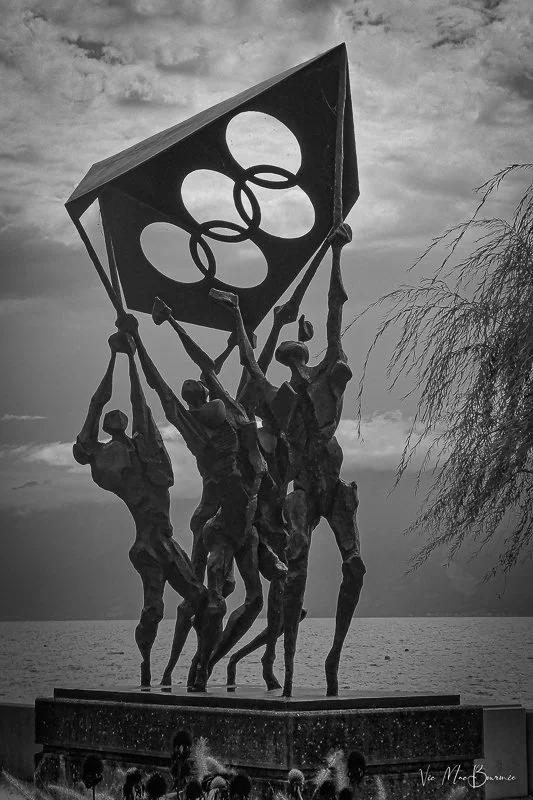
Olympic statue
Lausanne, Switzerland is home to the International Olympic Committee. This beautiful statue sits outside the Olympic museum. Originally photographed in colour and converted to B&W.
Fujifilm F660EXR Specs
Body type: Compact
Max resolution: 4608 x 3456
Effective pixels: 16 megapixels
Sensor size: 1/2" (6.4 x 4.8 mm)
Sensor type: EXR CMOS
ISO: Auto, 100, 200, 400, 800, 1600, 3200 (6400 and 12800 with boost)
Focal length: (equiv.)24–360 mm
Max aperture: F3.5–5.3
Screen size: 3″
Screen dots: 460,000
Max shutter speed: 1/2000 sec
Storage types: SD/SDHC/SDXCUSBUSB 2.0 (480 Mbit/sec)
Weight (inc. battery): 217 g (0.48 lb / 7.65 oz)
Autofocus
Contrast Detect (sensor)
Multi-area
Center
Tracking
Single
Continuous
Face Detection
Digital zoom Yes (2x)
Macro focus range: 5 cm (1.97″)

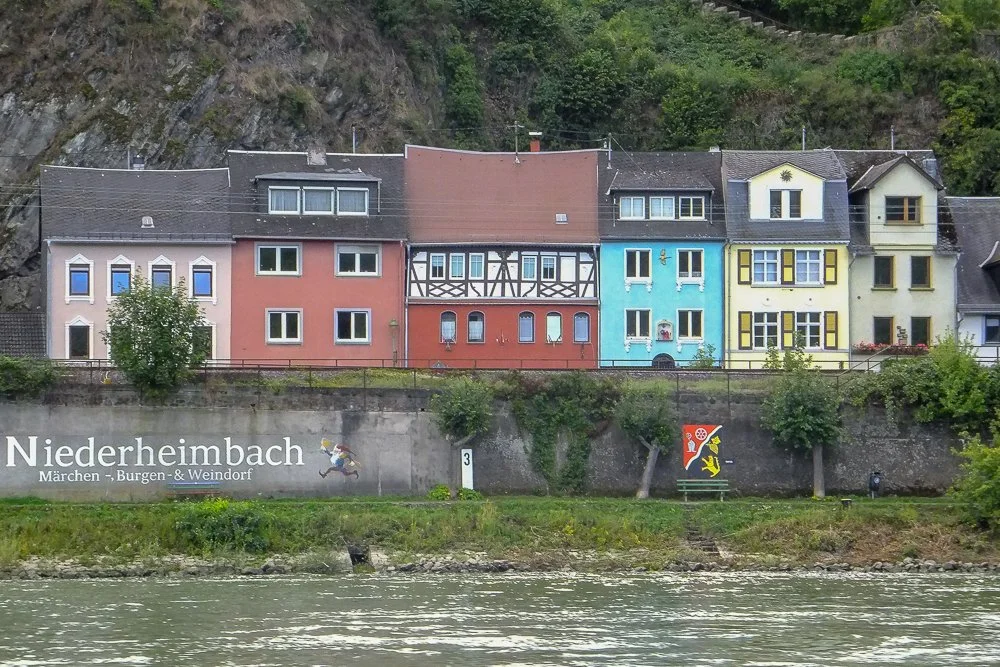
A street performer performs under a bridge in the city of Cologne, Germany.
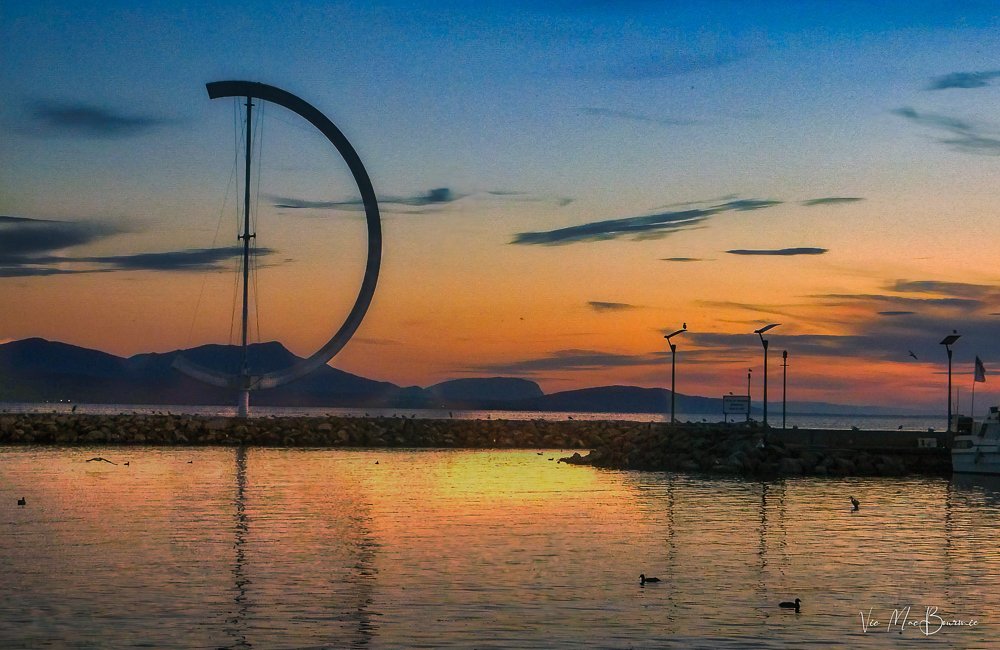
A harbour in Lausanne, Switzerland.
Based on the Fujifilm FinePix F-series history, there were at least 10 distinct EXR-model travel cameras released between 2009 and 2013.
10 distinct EXR-model travel cameras released between 2009 and 2013
These cameras were characterized by the EXR CMOS sensor technology, designed for high-resolution, low light, or high-dynamic-range shooting in a compact, portable body ideal for travel photography or as an everyday carry camera.
Key models in the Fujifilm EXR F travel zoom lineup included:
F200EXR in 2009 – the first to feature the EXR sensor
F80EXR/F85EXR (2010)
F300EXR/F305EXR (2010) introduced Phase Detection AF
F500EXR/F505EXR/F555 (introduced in 2011 adding GPS and RAW capabilities
F600EXR/F605EXR/ (introduced in 2011)
F660EXR/F665EXR Introduced in 2012
F770EXR/F775EXR introduced in 2012 along with the 20X zoom
F800EXR/F820EXR introduced 2012-2013
F800EXR/F820EXR introduced in 2012-2013
F900EXR introduced in 2013
The Fujifilm FinePix F660EXR is a 15x compact superzoom built around the company's EXR technology. It features the same 1/2" type 16MP CMOS sensor as the co-announced F770EXR, along with the same 3.0" 460,000 dot LCD but loses the more expensive camera's zoom range, GPS and Raw-shooting capability. It still offers an impressive 24-360mm equivalent stabilized zoom and 1080p movie shooting.




Tamron’s 500mm mirror lens: A forgotten gem
Getting in close doesn’t have to cost a fortune. Tamron’s 500mm F8 mirror lens is given new life with digital cameras and the latest in post processing software.
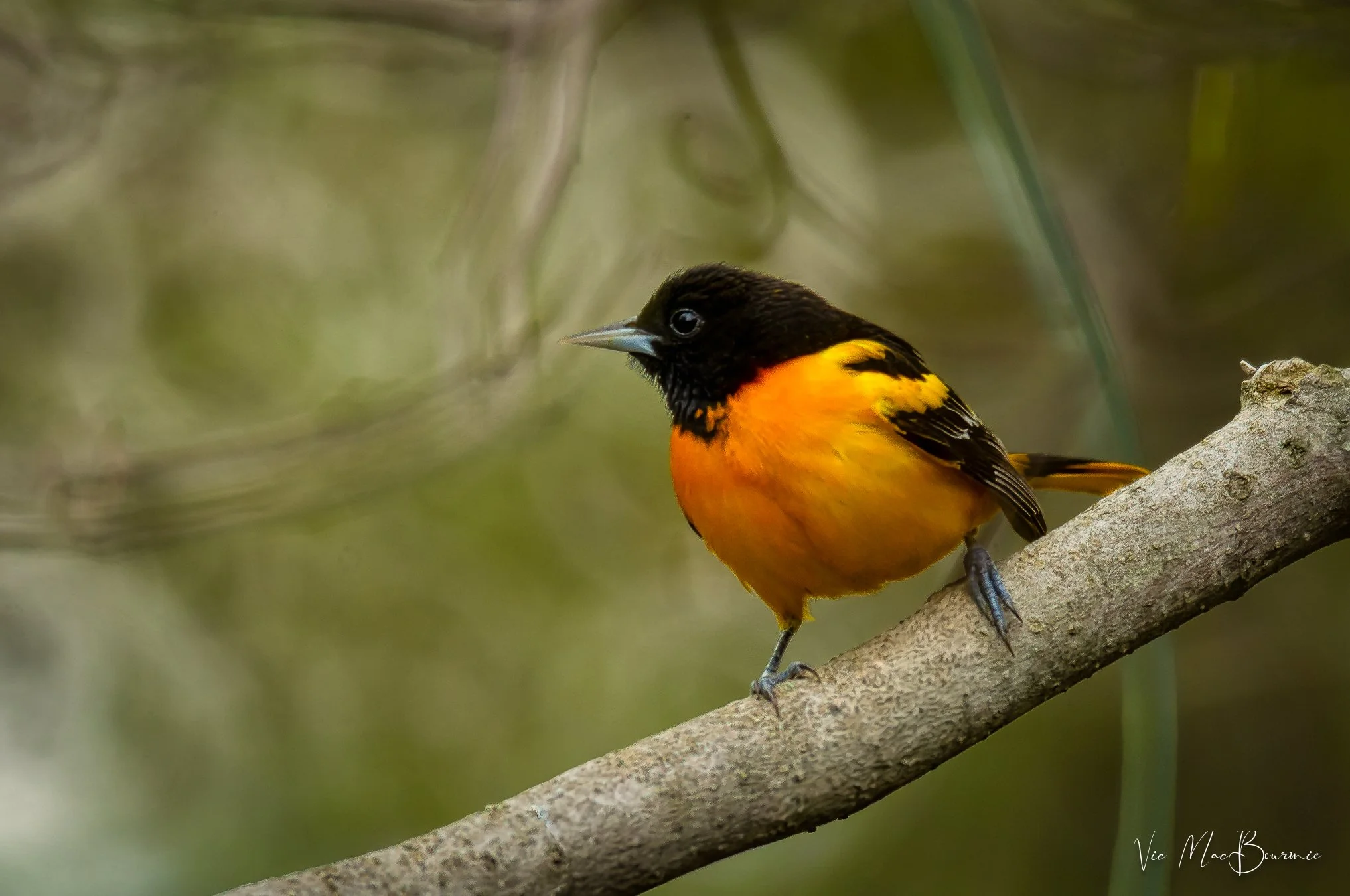
Here a Baltimore Oriole takes a moment before flying down to a feeder set up with oranges and grape jelly. The 500mm mirror lens with the added reach on the APSC camera allowed me to get in close. Who said these lenses are not capable of sharp images? The mirror lens’s bokeh also created this almost painterly background.
Modern cameras and post processing turn vintage lens into a woodland/wildlife gem
Years ago, I owned a Ricoh 600mm mirror lens. It was an f8 lens at a time when Kodachrome 64 was the film of choice and every image cost more than a few pennies.
The combination of manual focus with a darkened f8 viewfinder and a very slow shutter speed, together with a minuscule depth of field, made getting proper focus extremely difficult. Successful images were few and far between and the cost of film made using it difficult to justify.
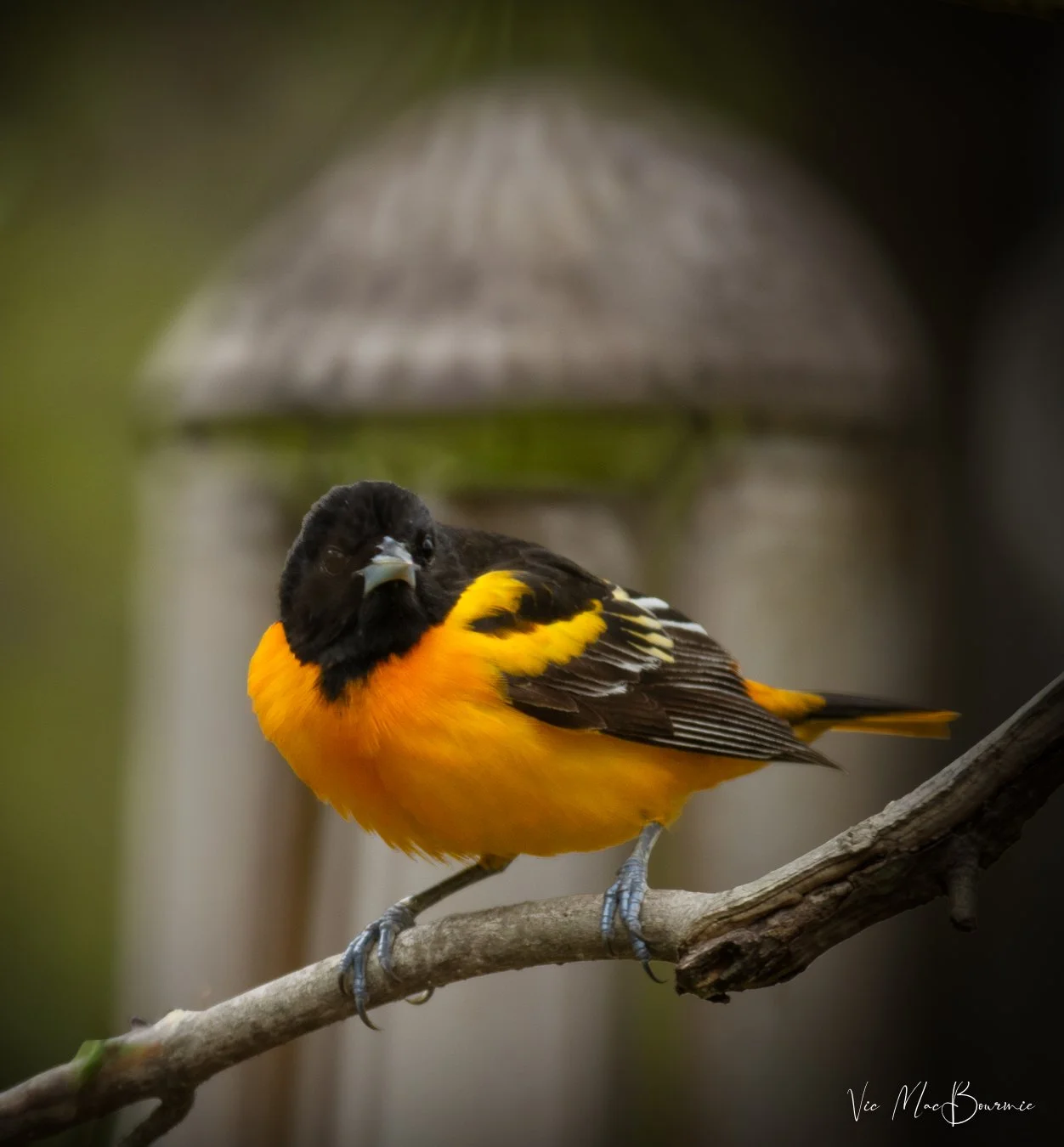
This image of the Oriole again shows the interesting bokeh the lens displays if there are no strong highlights in he background.
Needless to say a tripod and static subject was almost a necessity for success. And even then, it was wise to take several images to score a few respectably sharp ones.
Over time, that can get quite expensive, not to mention frustrating.

This image of a dark-eyed Junco was photographed through the double-paned windows of our back French door with the 500mm mirror lens. I think sharpness is certainly acceptable and although there is hints of donut bokeh, the overall bokeh is very nice in this image. Finding a simple background is key to success with mirror lenses.
A lot has changed since then, and a long supertelephoto mirror lens with a fixed F8 aperture is no longer considered quite the liability it once was.
Modern in-camera stabilization or IBIS, the ability to dramatically increase ISO and the freedom to shoot an unlimited number of digital images at no cost, transforms the mirror lens’s capabilities. Add to that, modern post processing programs with AI sharpening capabilities, and those near misses resulting from the super shallow depth of field, quickly become a thing of the past.
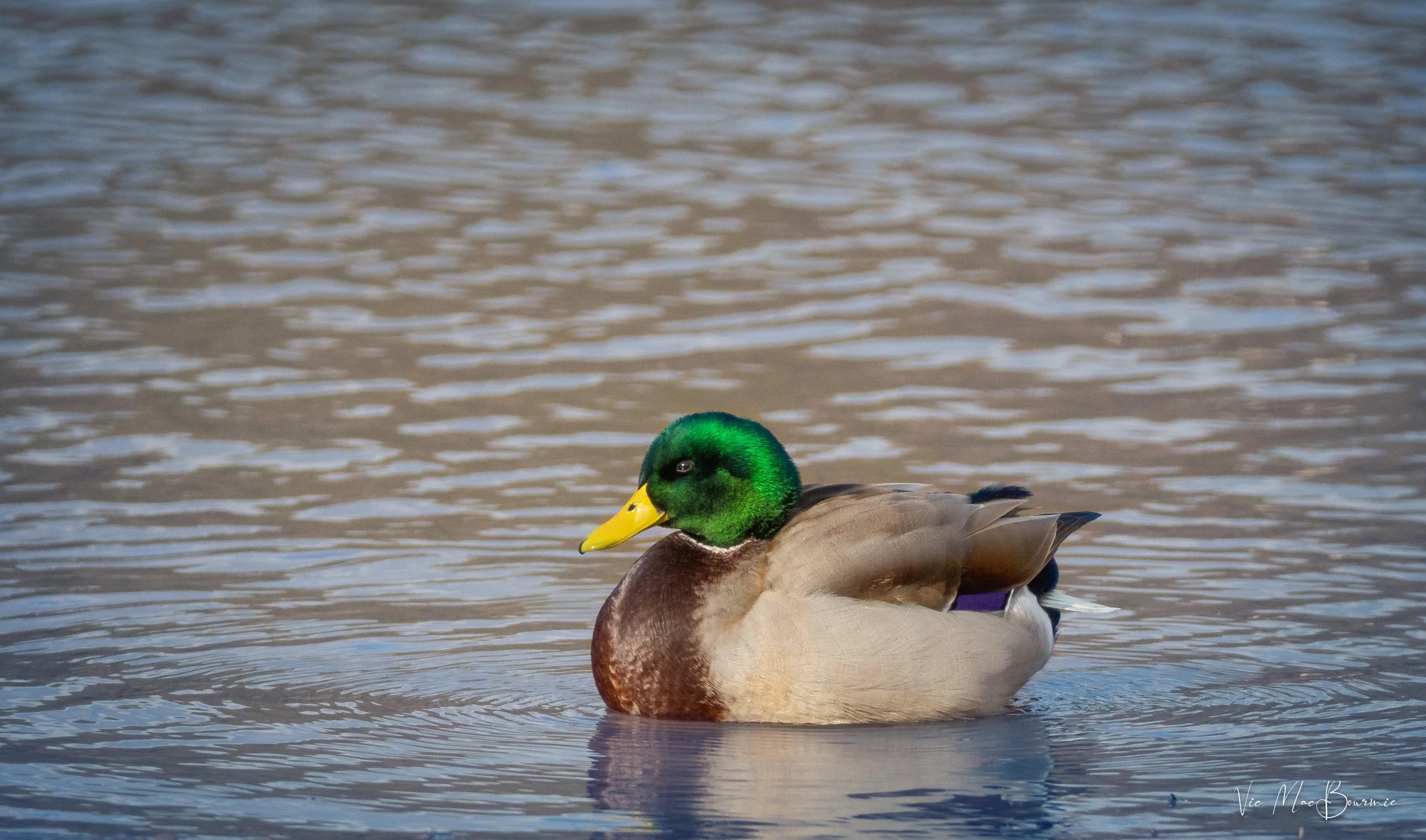
This mallard shows the possibilities of the 500mm mirror lens with a simple background.
In the short time I have owned the lens – and thanks to modern technology – I have found a corner in my camera bag and arsenal of photography tools for the Tamron 500mm constant f8 mirror lens. A major plus for the lens is its incredibly small size and especially its weight at only 575g.
And, for the mere $75 Canadian I paid for the mint-condition lens, I can say that it has already easily paid for itself a couple of times over. I expect even greater things in the spring, when I can get out and really put it to the test.
Just for comparison, a modern autofocus Nikon 800mm f6.3 lens will set you back about $8,500.00 US, or well over $10,000.00 Canadian. Now, it may not be fair to make the comparison, but it’s nevertheless still interesting. I guess it’s better not to even mention the $29,000.00 U.S. Canon 1200mm f8.
If a super telephoto lens with the latest autofocus technology is not something you would use regularly, a mirror lens like this Tamron SP 500mm might be the perfect compromise. I’m currently using it with my Pentax K5 APSC camera but will also be mounting it on my M4/3 bodies with an adapter. And, if I ever have the desire to shoot for the moon, attaching the 500mm mirror lens to my Pentax Q would give me the equivalent of about a 2,500mm lens.
Now that’s some pulling-in power.
Shooting through a double-pane French door at the birds outside my windows can result in some nice keepers when the weather outside is way below freezing.
In the meantime, I’m enjoying putting my $75 mirror lens through its paces in the eye of a Canadian cold front.
Mirror lenses making a comeback
If you’ve been following the latest trends in photography, you’ll know that mirror lenses are beginning to have a little resurgence of late.
TT Artisan, for instance, has released a tiny 250mm f5.6 mirror lens (Amazon link) that is making waves among photographers looking for a small, carry around lens with some telephoto reach. Its small size makes it perfect to carry around and the shorter focal length makes it easier to use whether you are shooting landscapes or street scenes.
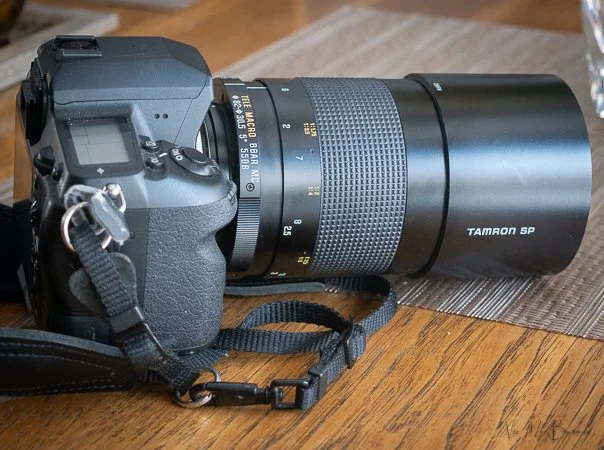
The Tamron 500mm mirror lens fitted to my Pentax K5 APSC camera making the effective focal length approximately 750mm.
And the donut bokeh that was always cited as a problem in the past, is being embraced by a new breed of creative photographers looking for a way to have their images noticed on social media.
But that’s not the only reasons mirror lenses are making a comeback.
Let me explain.

This goldfinch was also shot through a double-pane French door with the 500mm mirror lens. Notice the unusual bokeh giving the image a lovely soft look. This bird and the Junco above were just a few feet away 5-6 feet, allowing me to take advantage of the close-focussing ability of the lens.
Super telephoto that fits in your bag
On my APS-sized sensor on the Pentax K5 with IBIS, that 500mm becomes a close-focusing 750-800mm, f8 lens. Not only does the in-camera stabilization make it hand holdable in bright conditions, but the ability to bump ISO to unheard of levels when the lens was originally released in 1979, turns a once almost unusable lens into an everyday carry for photographers looking for an inexpensive super telephoto that easily fits into a camera bag.
It’s long reach is really only half the reason for my recent love affair.
Close-focussing from a distance
Its close-focussing capabilities are also worthy of mention. With a minimum focussing distance of 1.7meters (around 5-6 feet) and a magnification ratio of 1:3, the possibilities in the garden are endless.
The birds in this post, for example, were mostly right outside my window. And, while I had my fair share of throwaway images due to missed focus, the keepers make it all worthwhile.
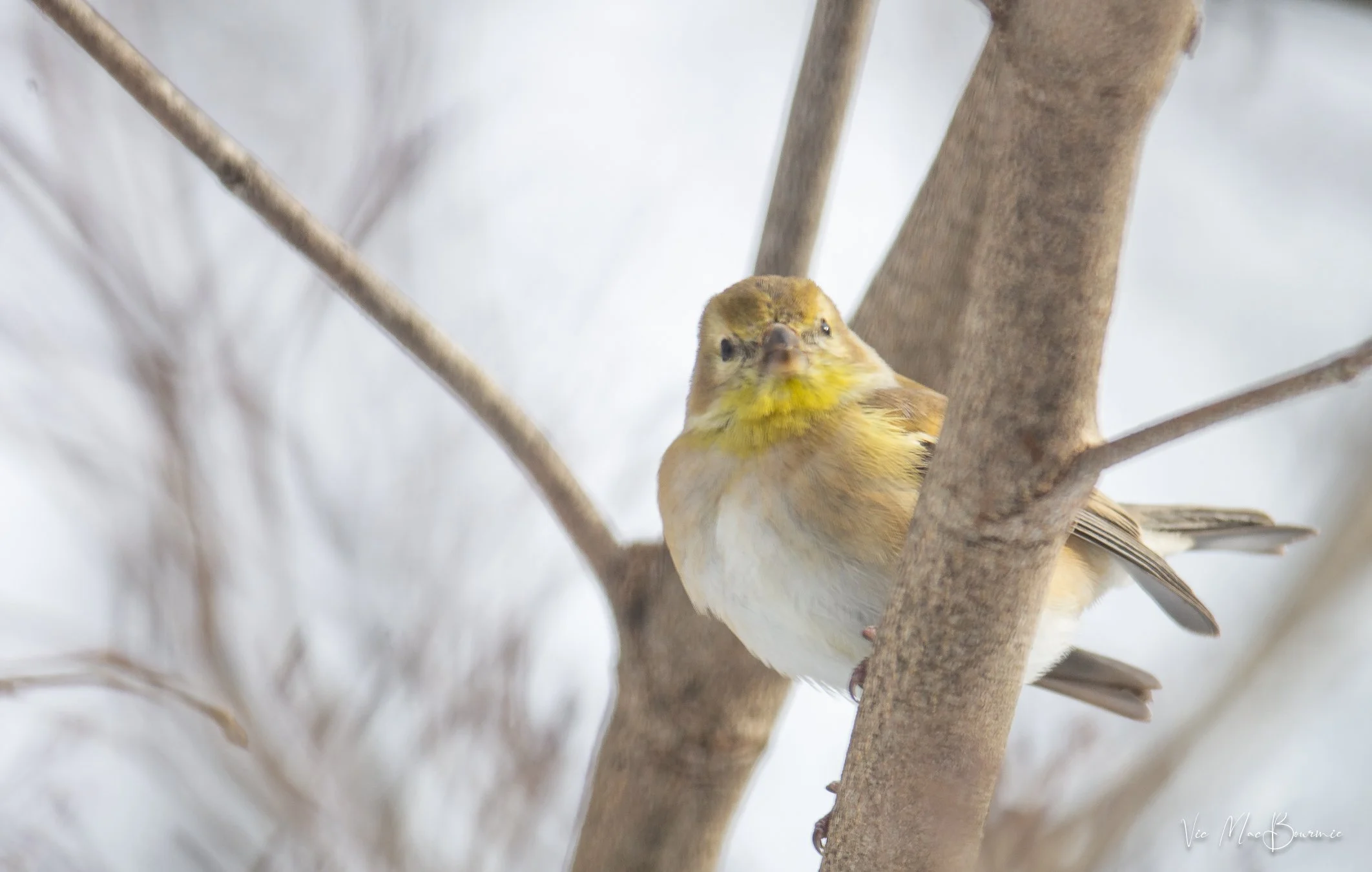
Another image of a goldfinch shot through a double-pane French door with the Tamron 500mm mirror lens.
Unusual bokeh can be a benefit
The other half is the unusual bokeh this lens exhibits. I’m not talking about the weird donut rings that can be effective but are mostly just annoying unless they are used creatively, I’m talking about the “other” bokeh few people seem to focus on when talking about mirror lenses. It’s a painterly effect that can be quite beautiful given the right situation.

This sleeping screech owl is the perfect subject for the 800mm equivalent lens on an APSC camera like the Pentax K5. In this case, a monopod helped me steady the camera and lens.

Here, the specular highlights are bringing out the donut bokeh in the lens that can prove to be a little distracting to many viewers. It can, however, be used in a positive way for creative results under the right circumstances.
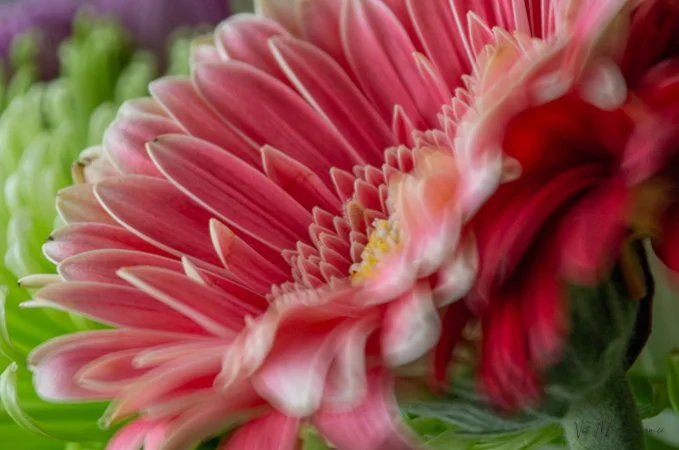
Another closeup image showing the flexibility of the 500mm mirror lens. At one moment you might be shooting a bird in a distant tree, and the next, a closeup of your favourite flower.
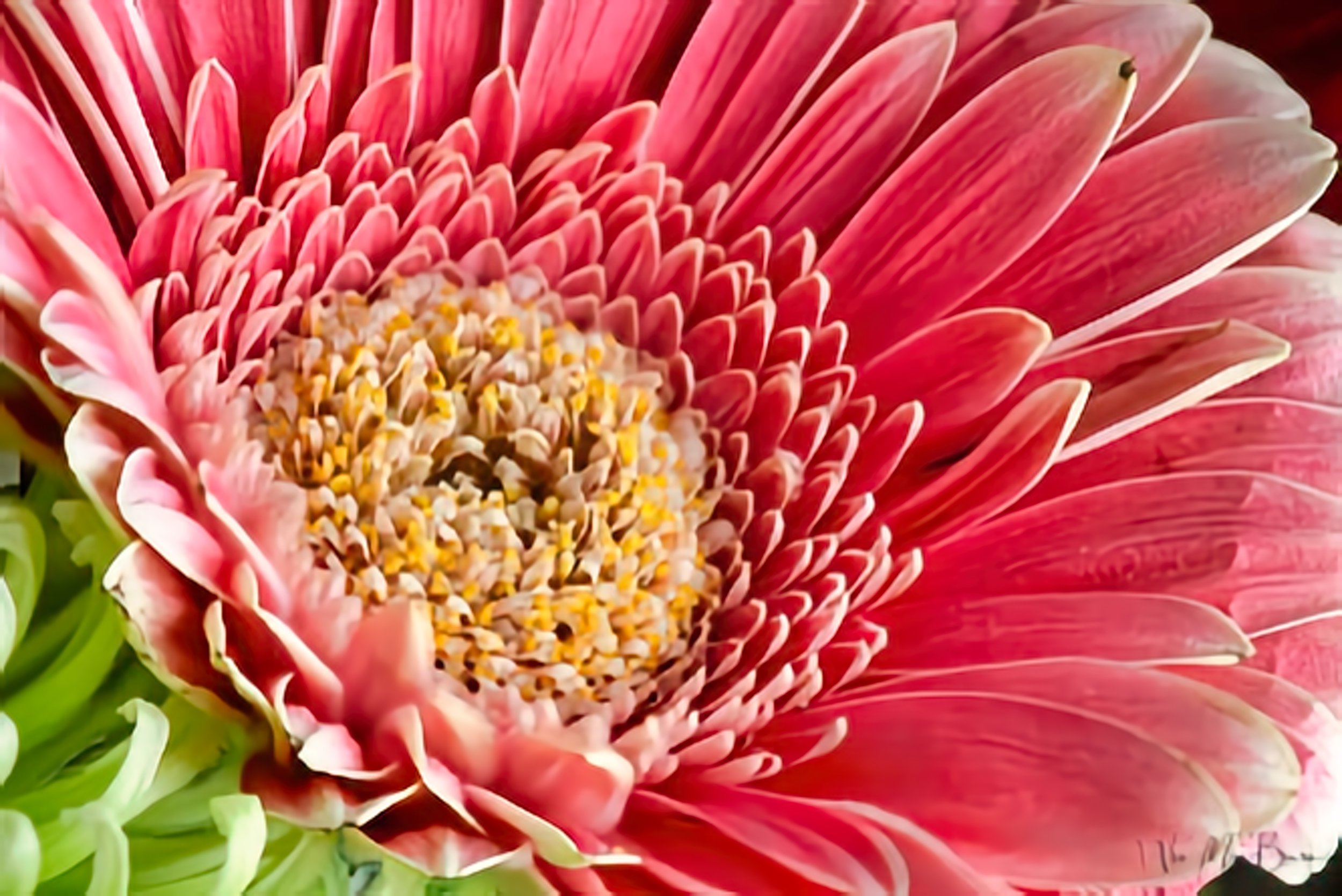
This extreme close-up of a flower is actually two images stacked together. Both images were taken with the 500mm mirror lens. Modern post processing programs help make the lens even more useable.
The owl image above gives a hint of the painterly bokeh in the out-of-focus green leaves in the background. The image below of a Junco in a snowstorm with two textures added, takes the painterly look to the extreme.

This is an interesting image that you might love or hate. Focus on the sparrow was a little off, but the overall softness of the image made it the perfect candidate to try adding some textures to create an even greater painterly effect. Here, two textures were added to get the finished result.
A little background on the lens
The Tamron 500mm mirror or catadioptric lens was originally introduced in 1979 as the smallest and lightest 500mm mirror telephoto lens ever produced. The lens was significant because it changed the thinking of optical engineers in the industry primarily because it uses Mangin mirrors. Mangin mirrors are lenses with one side of the lens being either aluminized or, in the case of Tamron's mirror lenses, silvered for peak reflectivity.
Light passes and refracts through the unsilvered front side of the lens element, reflects off the aluminized or silvered back surface, and then the light again passes and refracts through the front side of the lens element. The whole point of using Mangin mirrors within a catadioptric lens is to reduce weight and size by getting away from the heavy solid catadioptric lens designs and earlier conventional mirror lens designs which were nowhere as compact."
There are two versions of the Tamron adaptable lens known as 55B. One version is the same size as the later 55BB and has a screw in hood (This is the one I own.). The other is about 15mm longer body and has an integral sliding hood.
The 55B's are easily distinguishable from the later 55BB by the presence of the tripod mount, and the ribbed rather than dimpled pattern of the rubber grip. The lens was manufactured from 1979 to 1983.
For those who care, the optical construction is 7 elements in 4 groups. It has the high end BBAR multi coatings and a minimum focus distance (mm from film plane) 1.7m, with a magnification ratio 1:3
and a filter diameter: 82mm front; 30.5mm rear. It normally comes with a deep flock lined screw on metal hood that inverts for storage. Its Length (at infinity) 8.7cm with a weight of only 575g.
Adding a little sunshine during the cold winter months
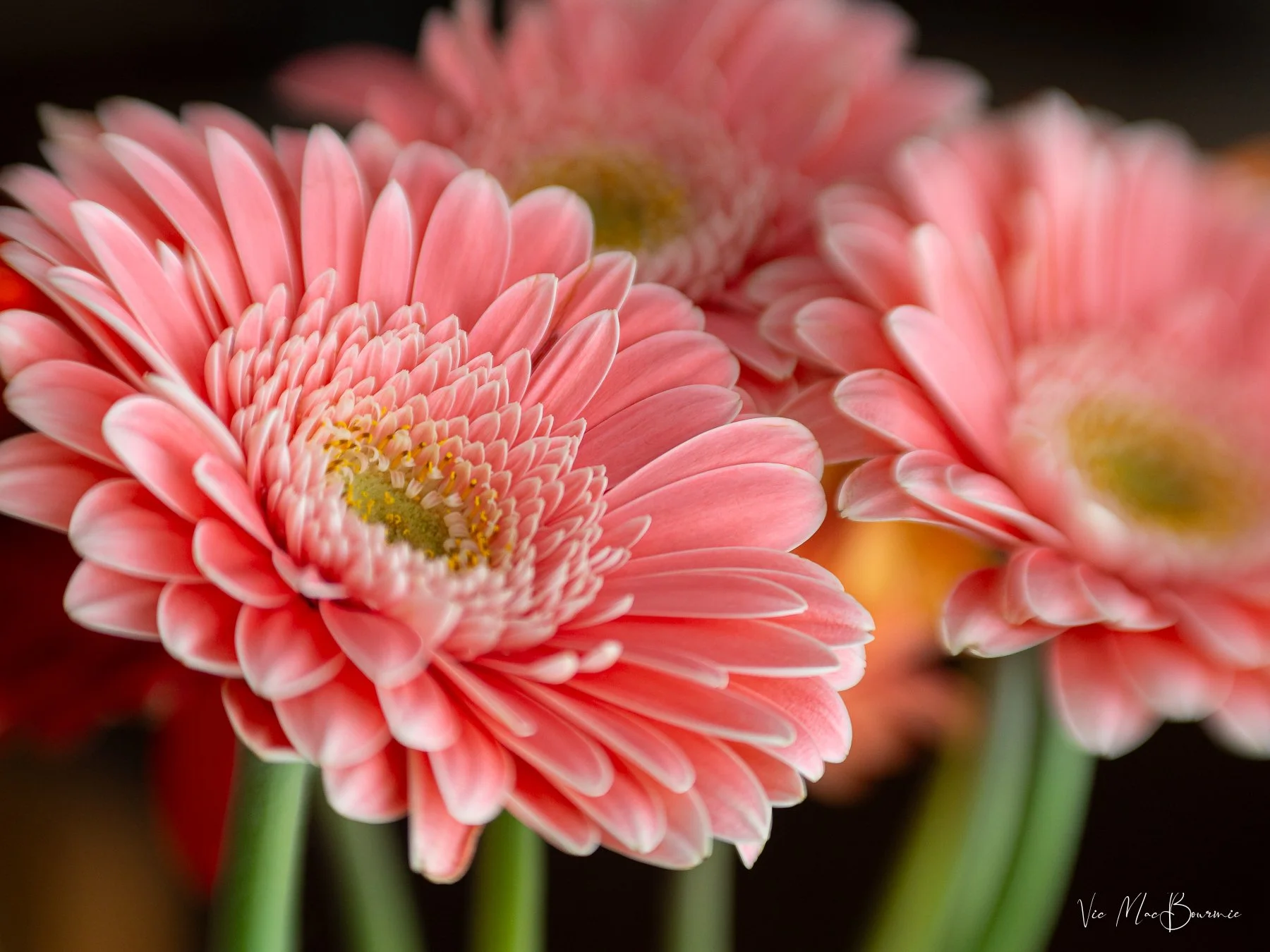
Bringing the garden into the kitchen with a bouquet of flowers and a handful of Lensbaby lenses.
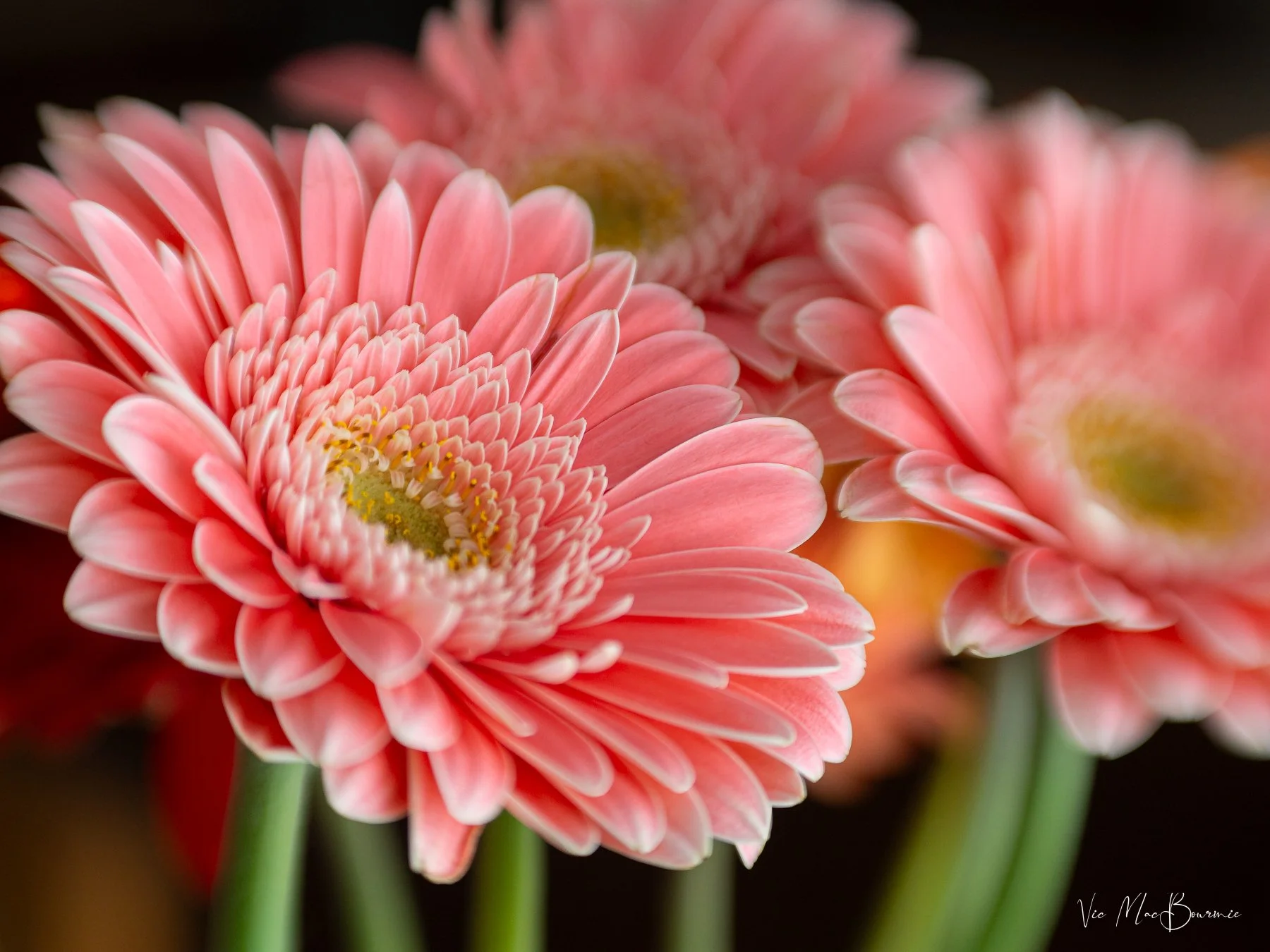
This image was made with the Lensbaby Composer and 50mm double-glass element at f2.8 with an Olympus EM10. My goal was to get an image to establish the general scene. From this image, I began to move in closer and closer to create more of abstract images working with soft, delicate lines and colours.
Lensbaby takes creative flower photography to new heights
Winter has set in and taken a firm hold of the garden, but that’s no reason not to let the sunshine in.
This week I decided to pick up a bouquet of flowers so I could get back to one of my favourite pastimes – photographing flowers. Rather than shooting in the garden, I brought a little of the garden into the kitchen where a large bay window allows a lovely soft light to bathe the flowers.
Even if you have no intention of photographing the flowers, it’s never a bad idea to bring a little sunshine into our homes during the long days of winter. We could all benefit from a little happiness these days.
It turned out to be the perfect opportunity to put a few Lensbaby lenses to good use. The following images are a little taste of my morning with a trio of Lensbaby lenses.
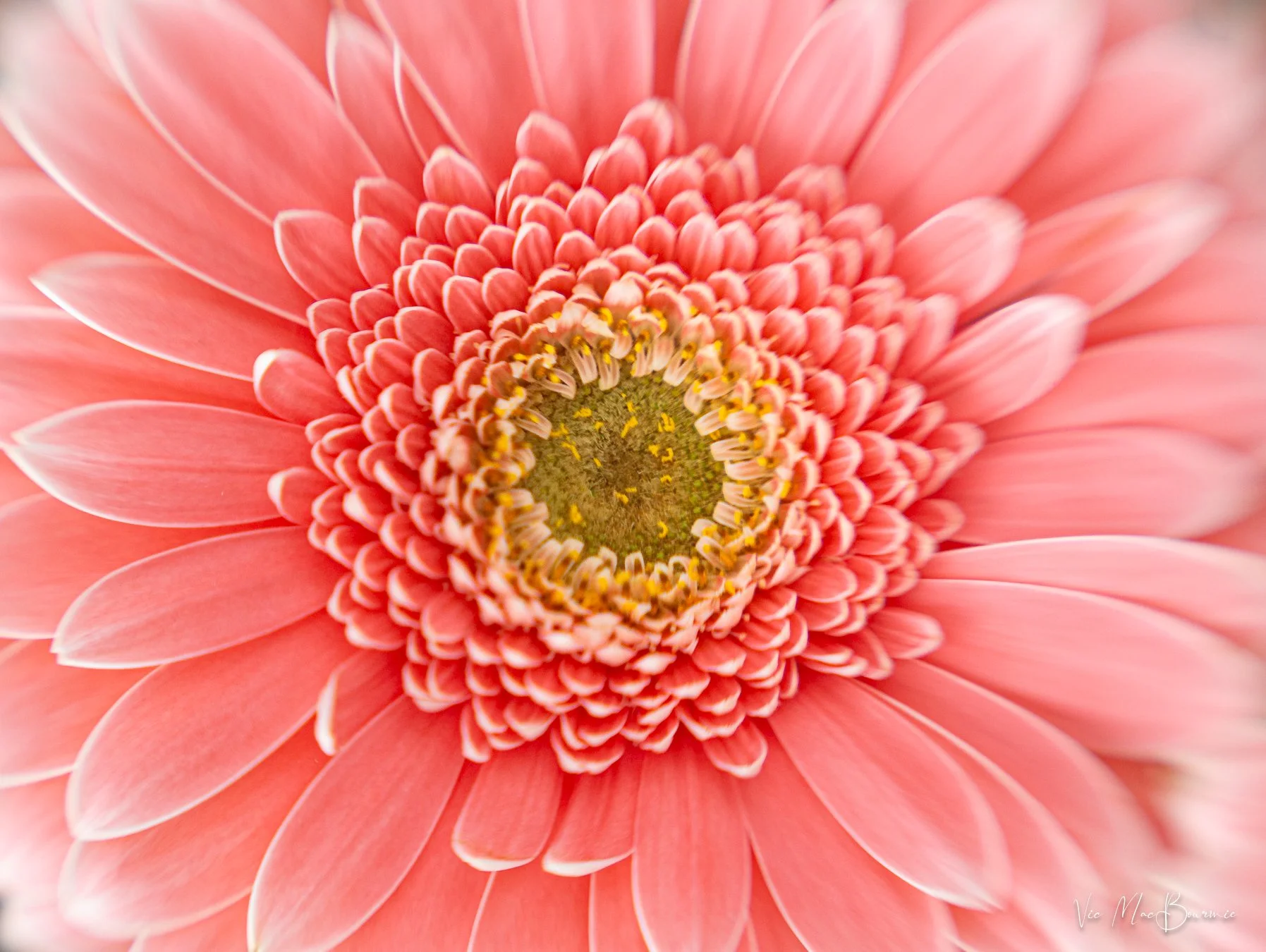
Moving in a little closer with the Lensbaby composer creates a delicate, soft-focus image with a very graphic element to it. Perfect focus can be difficult with Lensbabies, especially in the more wide-open aperatures such as f2.8.
Getting creative with a trio of Lensbaby lenses
If you are not familiar with Lensbaby lenses, they are specially designed lenses aimed at encouraging photographers to have a little fun by adding a more creative element to their images, mostly in the form of selective and soft focus.
Unlike traditional lenses, the goal is not to attaina perfectly sharp, sterile image.
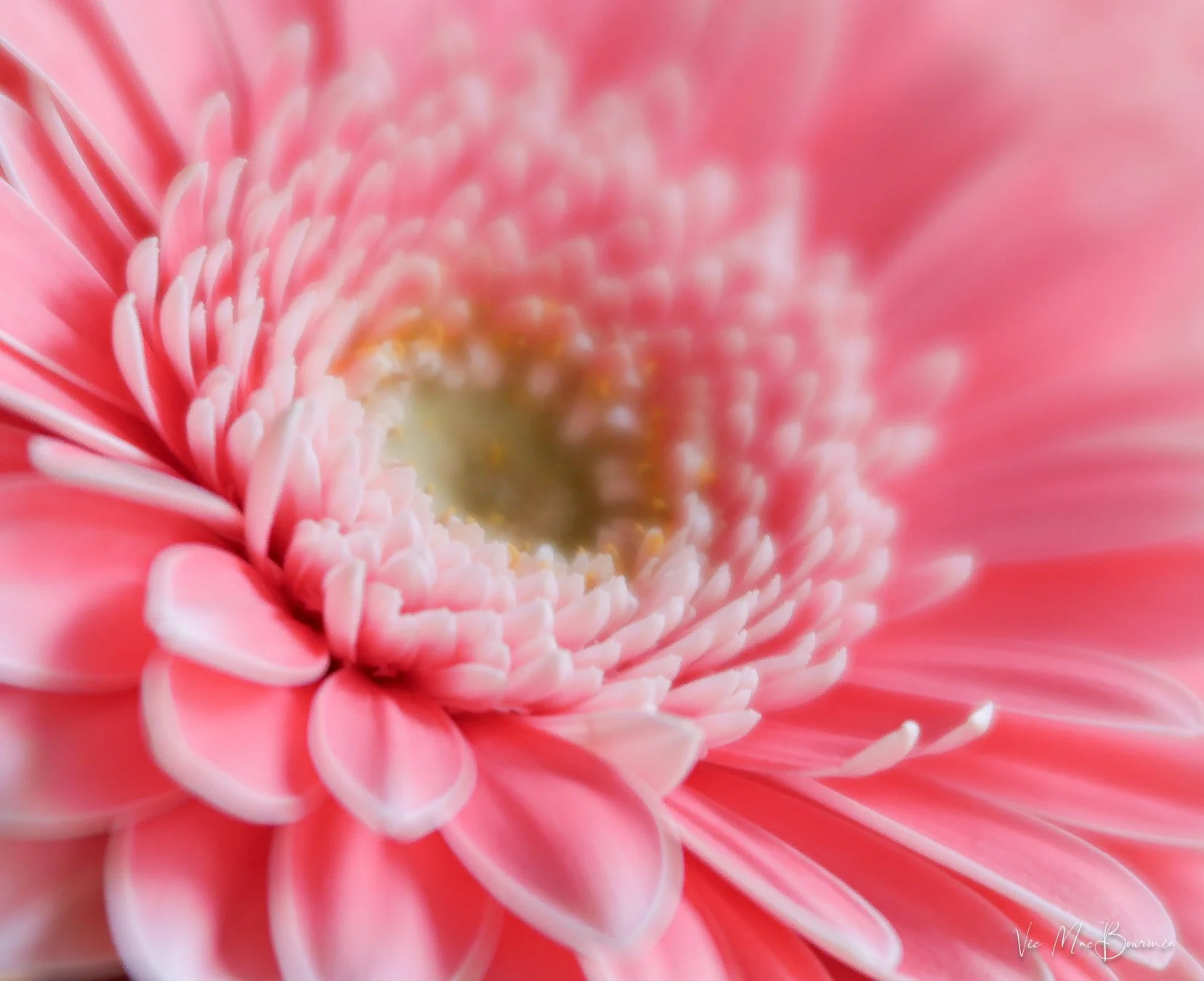
This image was taken with the Lensbaby Velvet56 on a Lumix GF7. The Velvet series of lenses are able to focus very closely making them ideal for flower photography. The Velvet series of lenses create a dreamy, more ethereal look that sports a sharp centre and soft, glowing halo around subjects. Some would say they have a vintage look to them and are ideal for flower photography and portraits. Stopped down a little at F4-8 and beyond reduces the soft-focus effect and makes them ideal for landscape images with a dreamy look.
One Youtuber describes experimenting with Lensbabies like sitting at the high school lunch table with all the artsy students complete with body piercings, vintage clothing and “interesting hair colour.” Now, while I can’t say that would describe me in high school, it sure sounds like hanging out with them would be a lot more fun than talking calculus.
Nothing wrong with perfectly sharp, perfect sterile images, but, when it comes to creative flower photography, sharp and sterile just doesn’t make the grade.
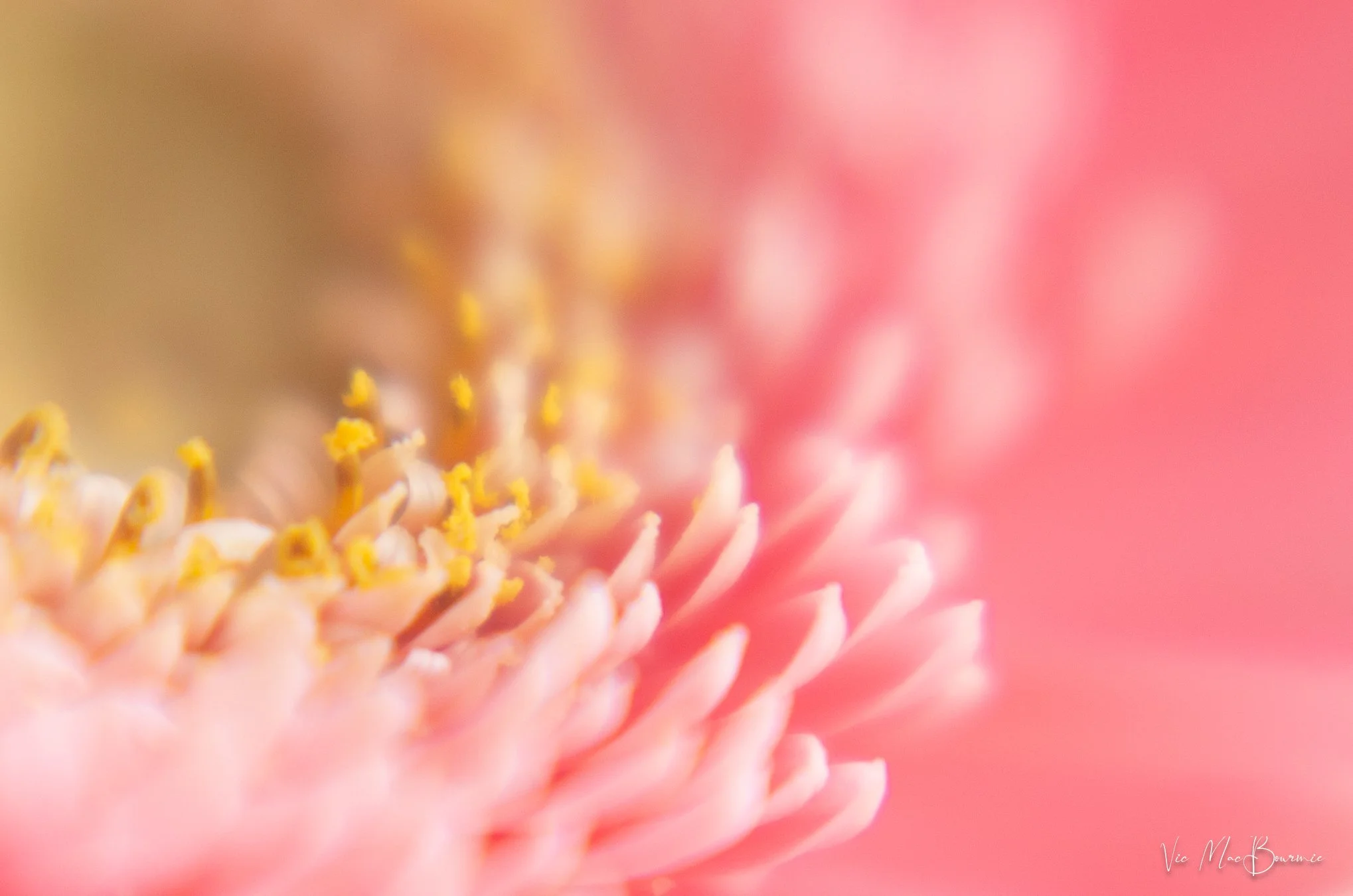
This image was made with the Lensbaby 2.0 at F2.8 on a Pentax K5 camera. Two Lensbaby macro filters – the 4X and 10X – were added to allow the extreme closeup.
For these images, I used a combination of a Lensbaby 2.0 with a double-glass element 50mm lens, a Lensbaby Velvet56, and a Lensbaby Composer with a double-glass element 50mm. In addition, I used Lensbaby’s 4X and 10X macro filters to move in extremely close for some images. The macro filters can be stacked for even closer views.
All Lensbaby lenses are manual focus and do not have electrical contacts to communicate with your camera body. As a result, settings on many cameras need to be adjusted to work with these lenses. I usually use them on aperture priority and use the +/- compensation adjustment for fine tuning the correct exposure.
There are several other Lensbaby lenses available that create a variety of different effects.
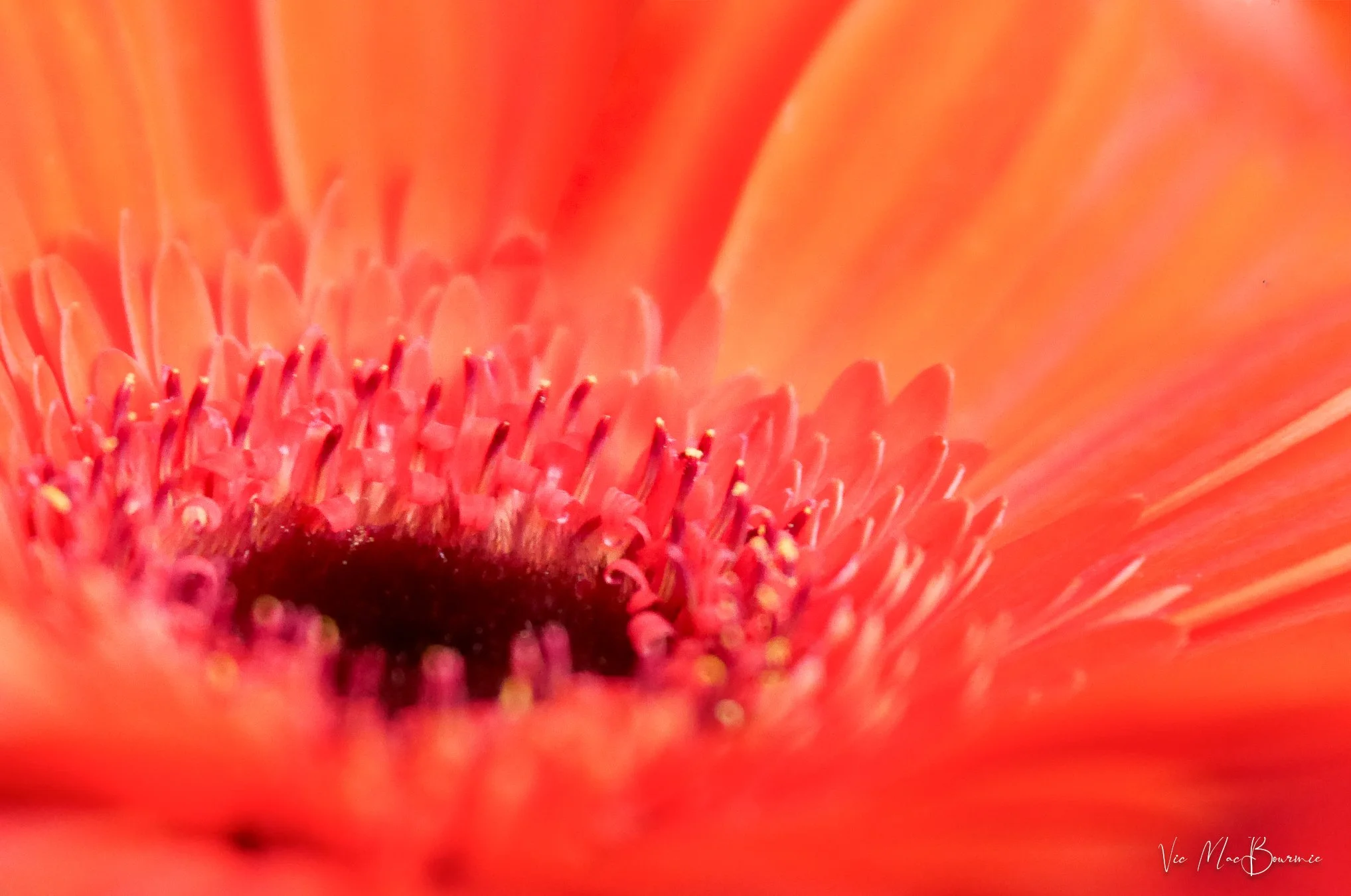
This image was made with the Velvet 56 at around F4.
For more information on Lensbaby lenses, go to the Lensbaby website here.
Here is an Amazon link to Lensbaby lenses for those interested in pursuing this very fun and rewarding form of photography.
While Lensbaby lenses can be used for any type of photography including portraiture, street photography and landscapes, they really shine when it comes to capturing soft, delicate and impressionistic images of flowers.
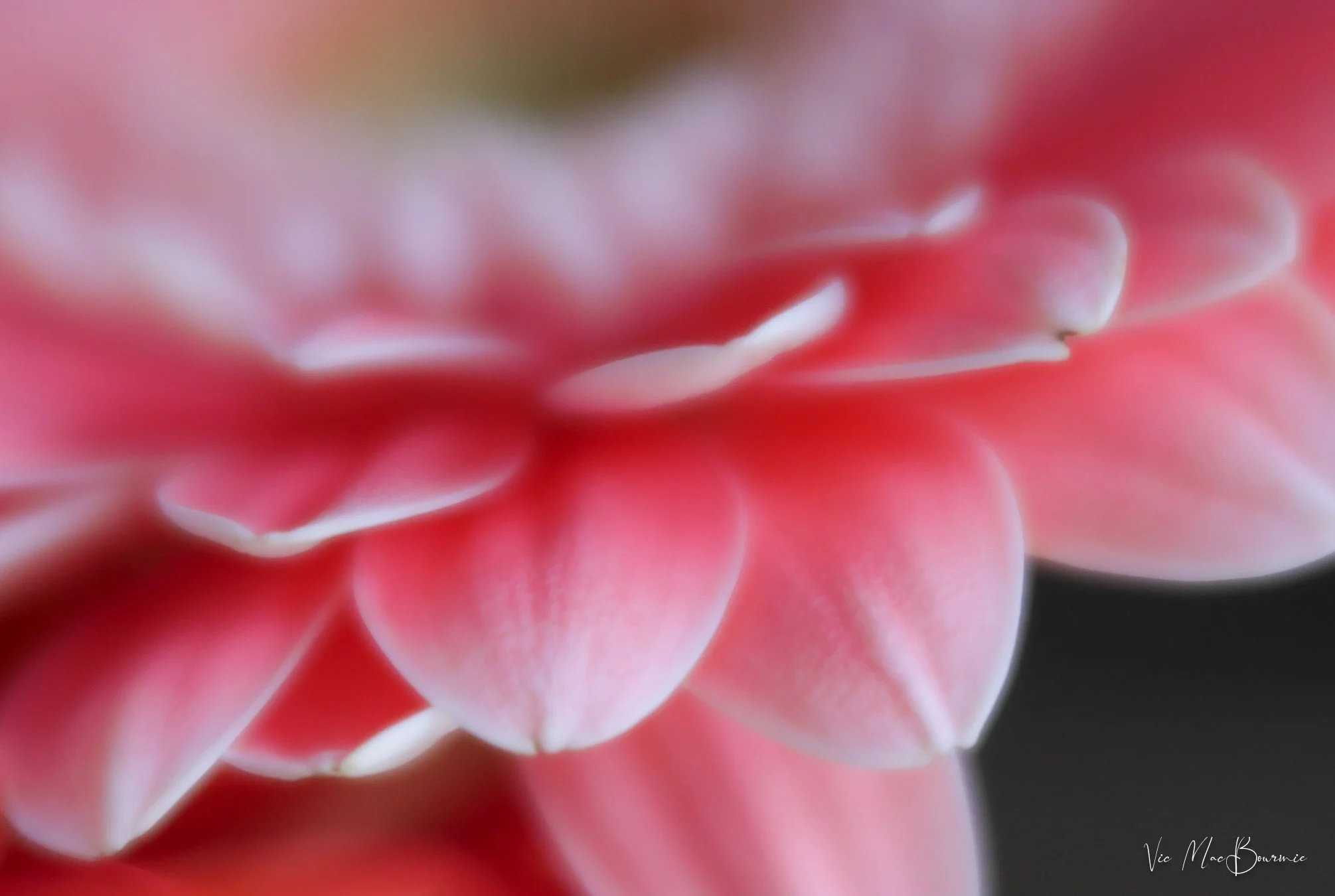
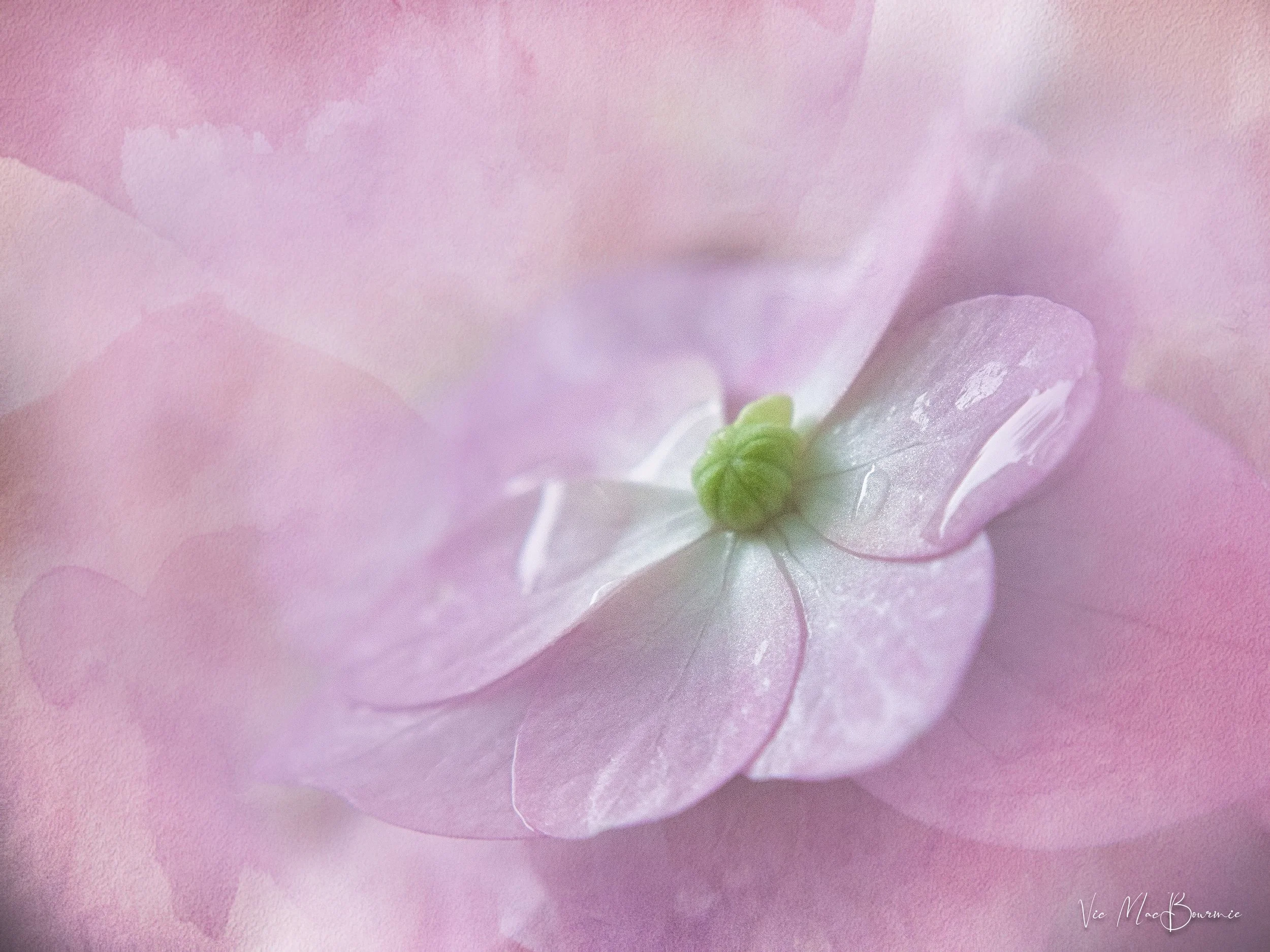
Capturing the flower petals in a lovely soft light with the Velvet56. The Velvet series of lenses, which include a 28mm wide angle lens, look more like traditional lenses rather than the more unique looking Muse, Composer and Spark designs.
These images are just a few examples of my recent morning with a trio of Lensbabies and a handful of flowers on a cold winter morning.
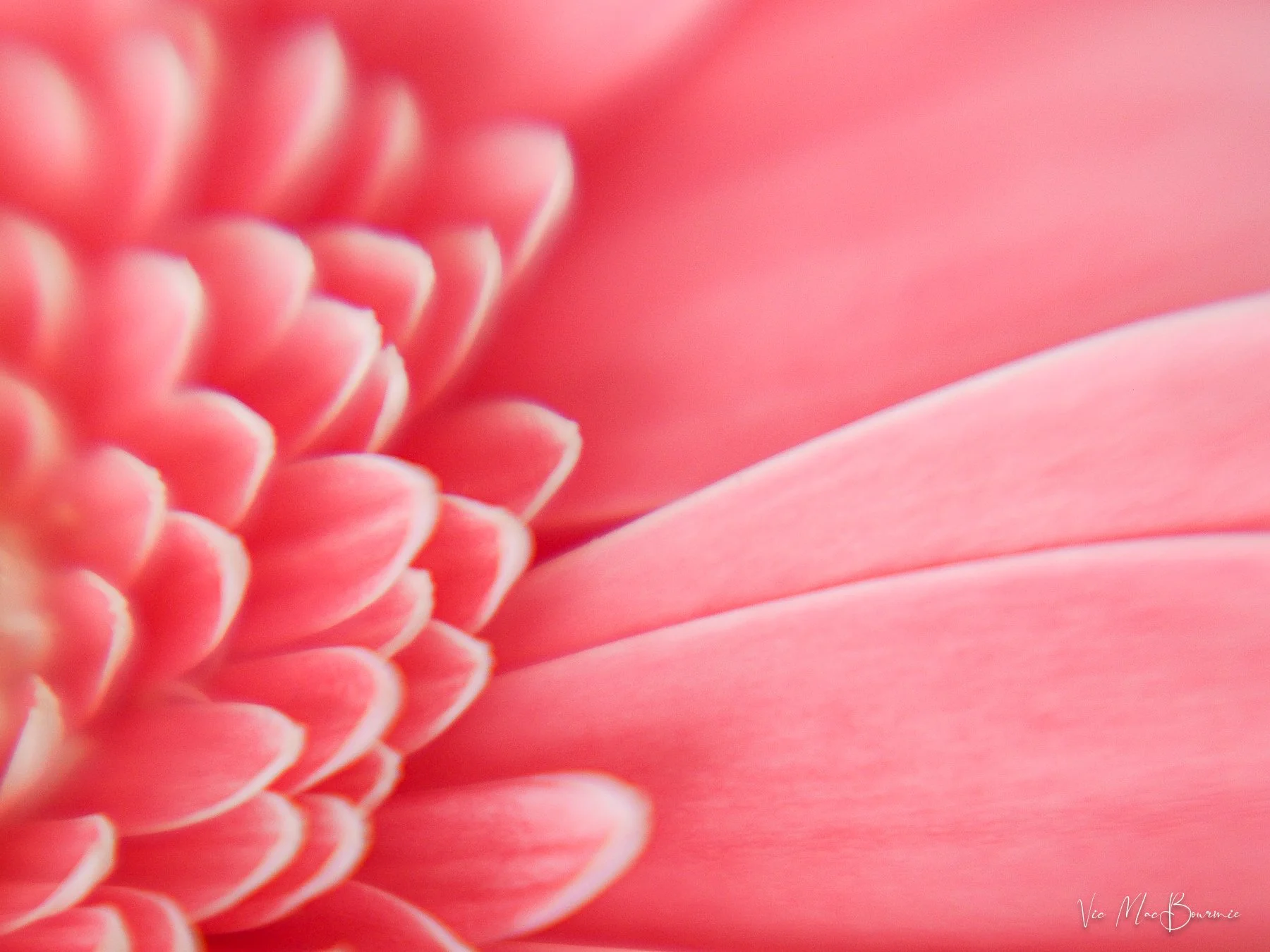
Moving in close to explore the details of a flower using the Lensbaby macro filters takes the image more into the realm of abstract. I focussed on the lines leading into the inner flower petals for this abstract image.
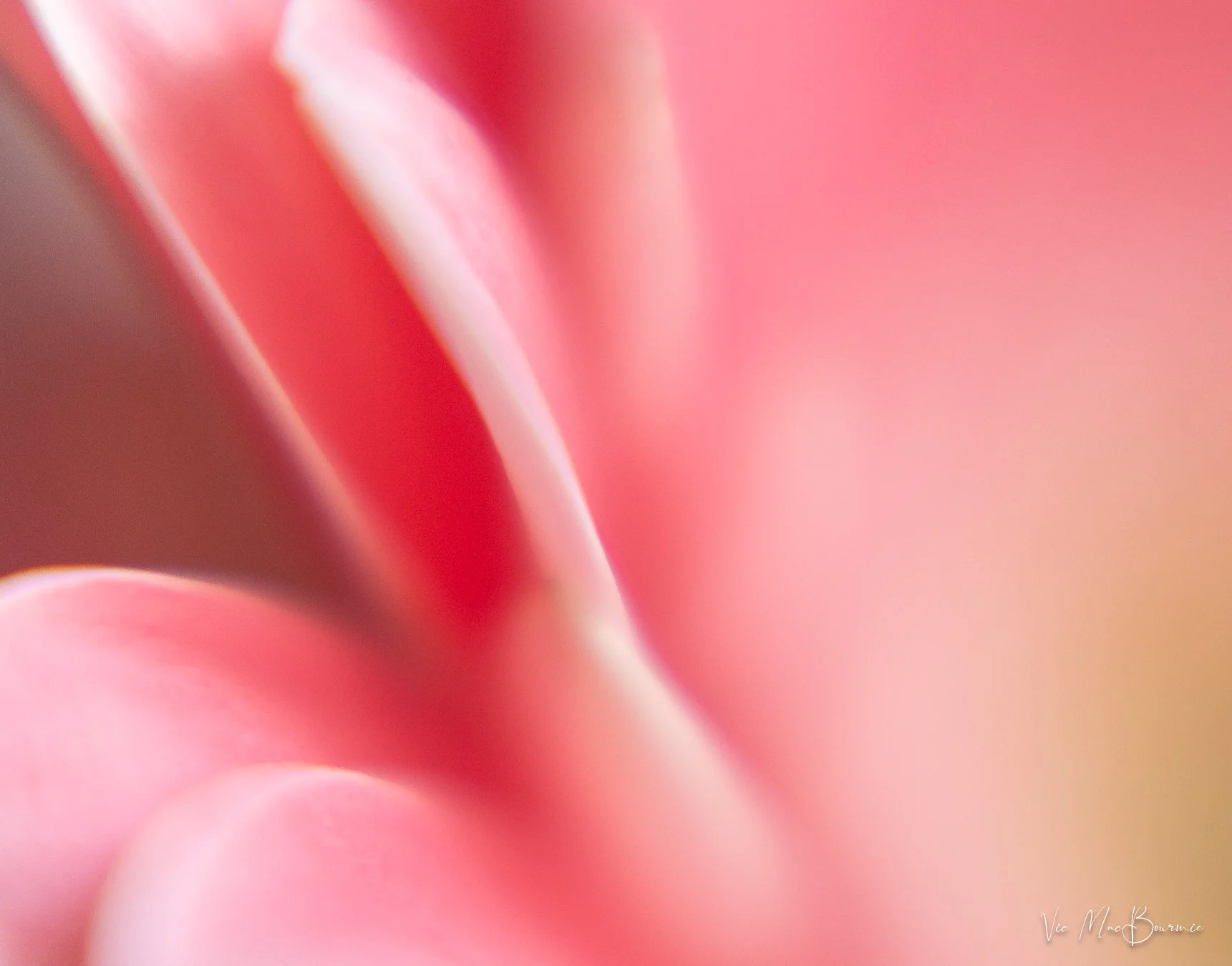
Again, moving in close and having fun using shapes, lines and colours helps to free your mind from trying to capture a sharp, traditional image of a flower.
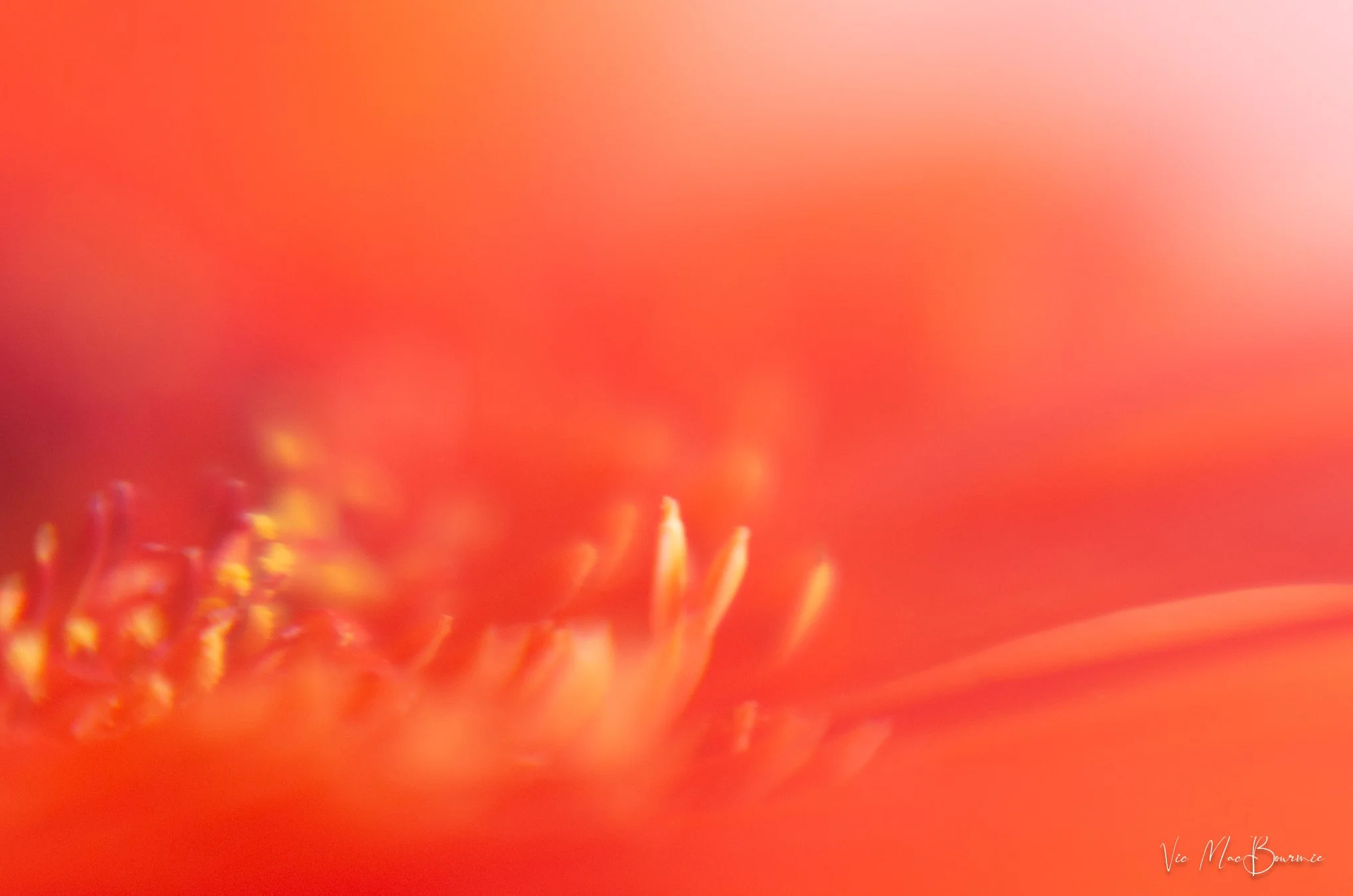
In the world of Lensbabies, sharpness and realism is certainly overrated. Exploring visually opens up a whole new world and creates a sense of freedom in your photography.
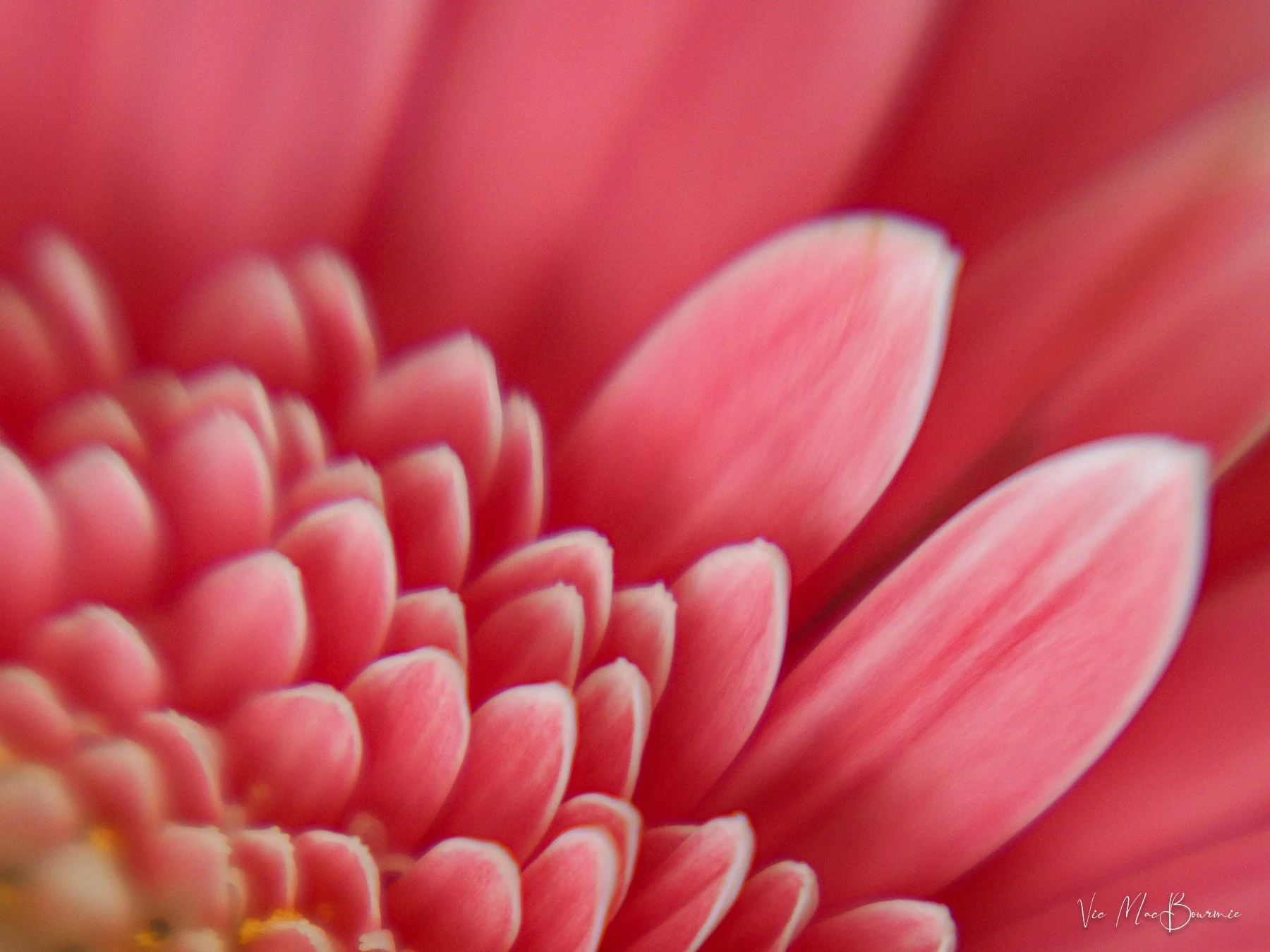
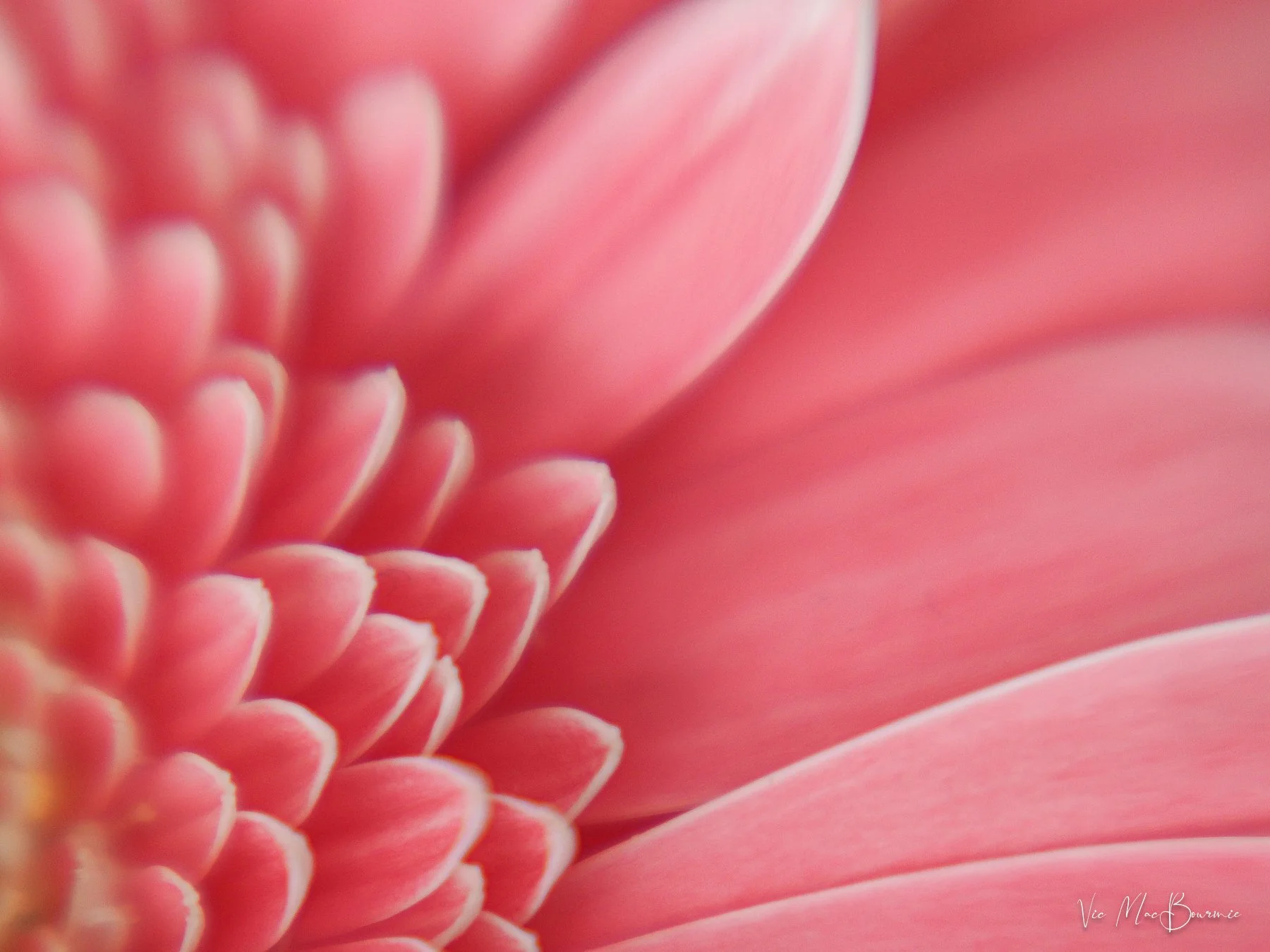
Small changes in perspective can take your images to a whole new level. This image, along with the one below are similar but different and allow small movements within the lens (not the camera) to change the look of the image as well as the focus.
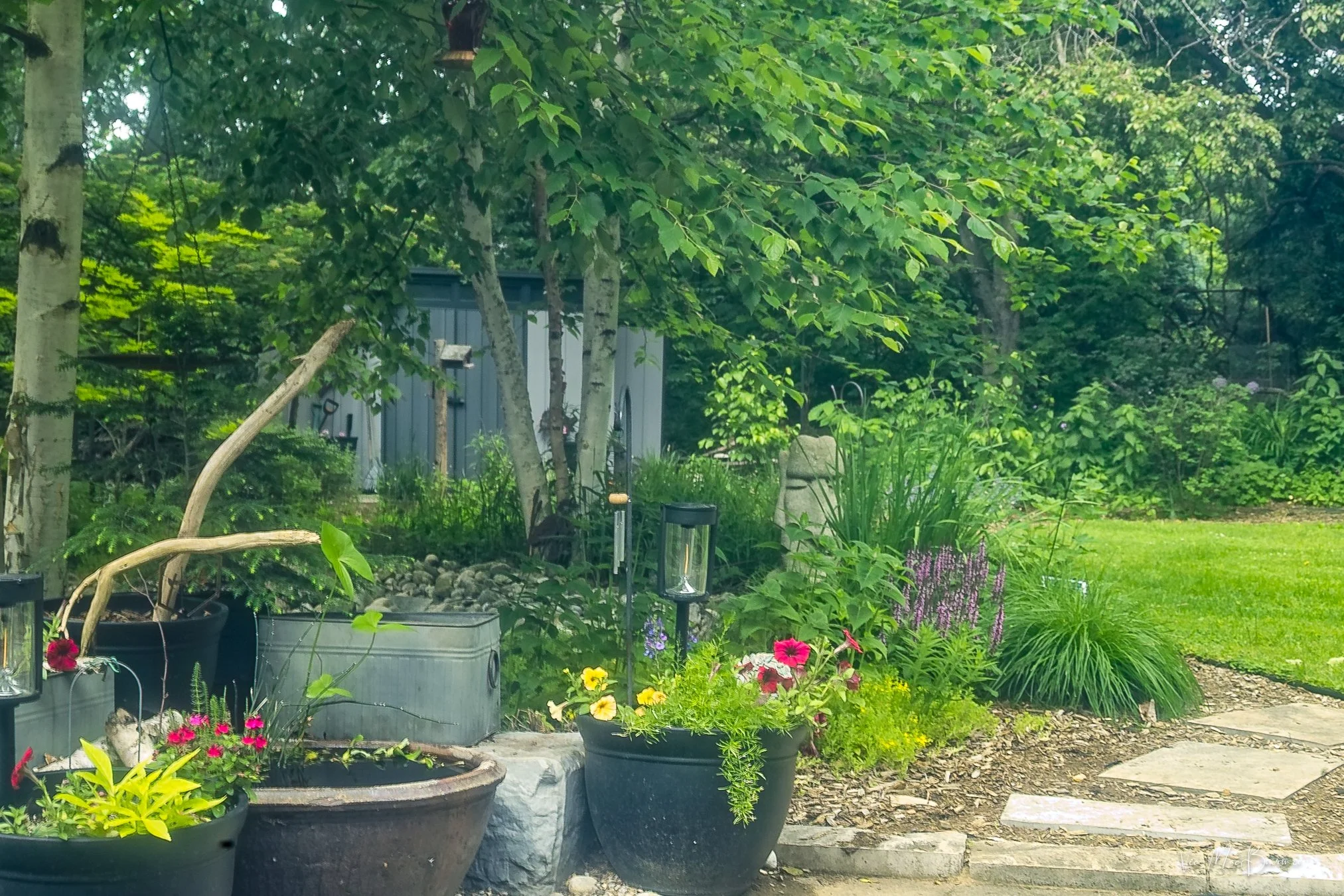
The Foveon sensors in Sigma cameras may be difficult to work with but the results can be stunning.