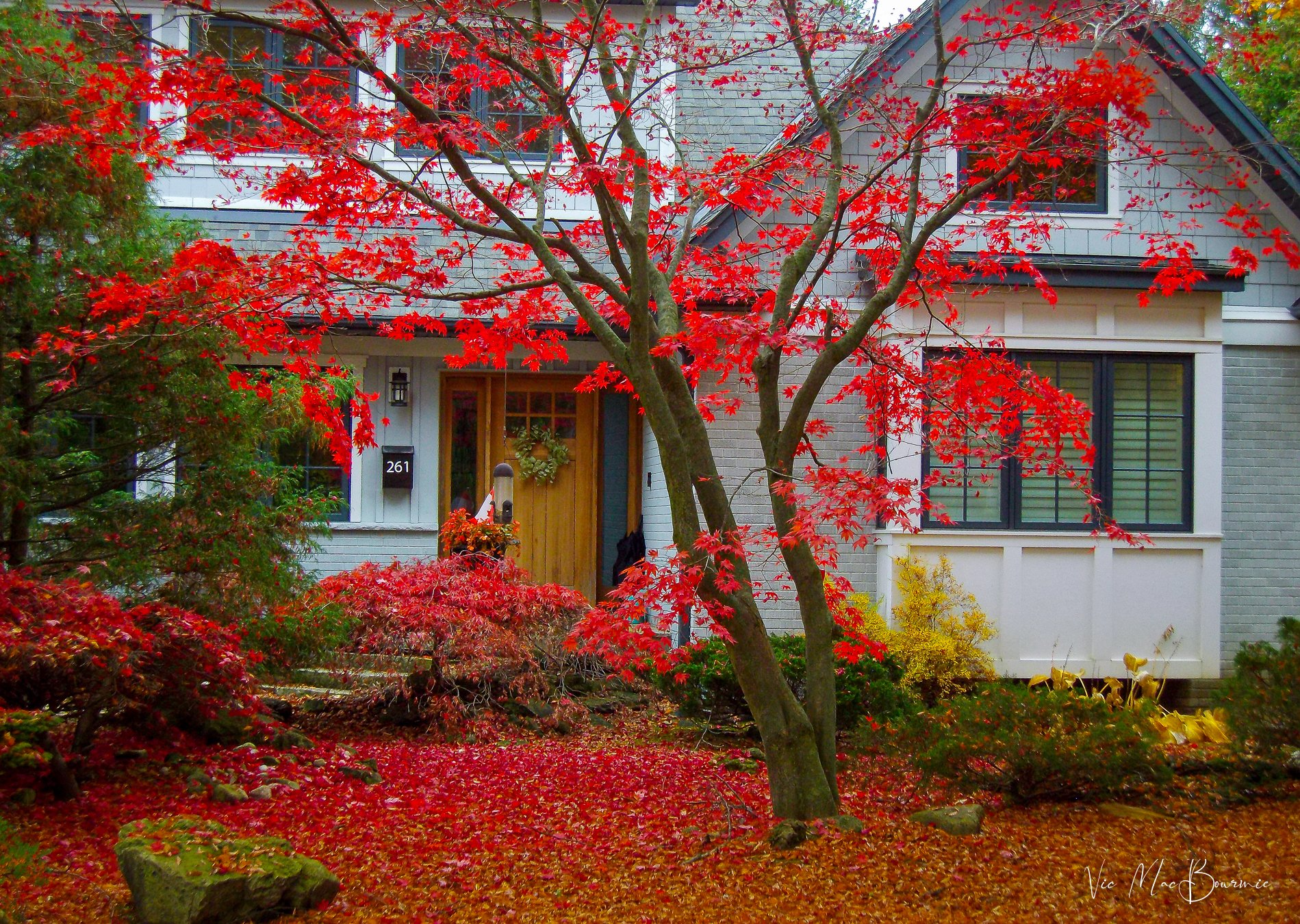
This mature Japanese Maple in full fall colour is stunning against the neutral grey background of the home’s painted brick. You may not want to paint your brick grey to enhance your landscape elements, but looking for a simple plain background to highlight a favourite tree is a design feature worth considering. (See below for that same tree against a darker evergreen background. Notice also, that the Japanese maple is properly pruned to allow it to grow in a natural shape rather than being pruned into an unnatural, ball shape.
Finding inspiration for your own landscape
Strolling through the neighbourhood in every season is a great way to both discover the latest landscaping trends in your area and see what plants and trees do well in the local landscape.
If you share your garden with deer, rabbits or other garden nibblers, discovering what plants that are resistant to these critters is certainly an added bonus.
Most recently, I popped a favourite point-and-shoot digicam into my coat pocket, (Click here for post on one of my favourite point-and-shoots) hooked up my dog, Colby, on his leash and set off in search of new ideas for the fall garden.
It didn’t take long to discover a few gems.
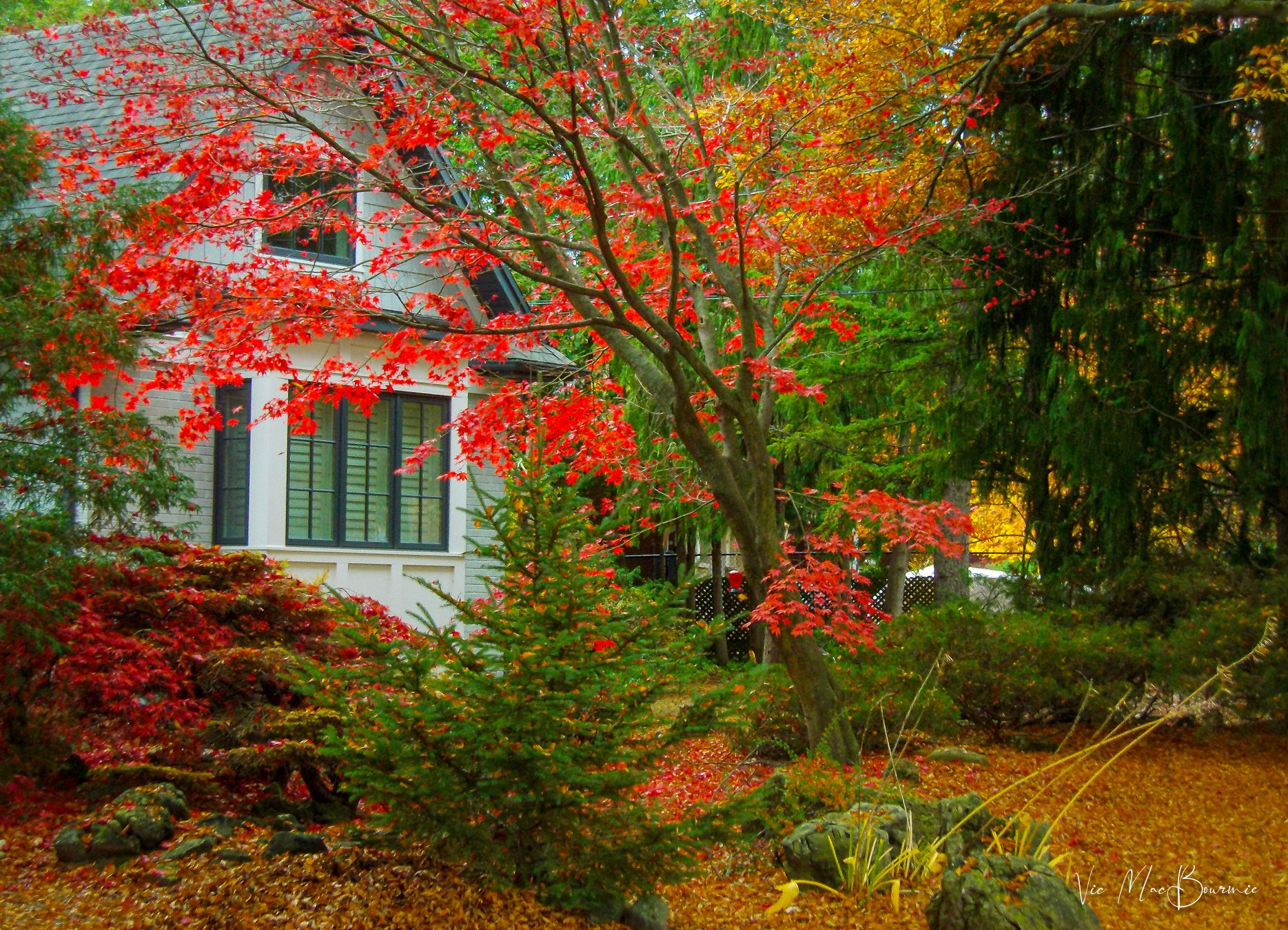
This beautiful, mature Japanese maple in full fall colours is enhanced by the evergreens that surround it. The bright greens are the perfect contrast to the vibrant reds. If you are planting a new Japanese Maple, consider growing evergreens behind or around it to provide these contrasting colours and a dark background.
Document inspiring moments for your own landscape
By zooming in on your favourite garden details, you can put the images into a digital folder or pin them to your Pinterest pages for both inspiration and action come spring.
Exploring different parts of the neighbourhood provides new areas of inspiration both for the gardener in me, and, of course, our dog who gets to sample new smells at every corner.
Let’s take a look at a handful of inspirational ideas from my latest fall stroll through the neighbourhood.
Image 1 and 2 (above): The two images above illustrate how a tree (such as a mature Japanese Maple) can transform a landscape and steal the spotlight during specific seasons. While a Japanese maple is a tree that provides year-round interest, it is particularly attractive in fall when its bright red leaves stand out against the simple grey background of the house, as well as the dark green background of the evergreen trees.
What can we learn: Consider planting our feature trees in an area where they can stand out from the background, be it a fence, our house or a wall of evergreens. Keeping the background simple is a key to this success. Watching how the light hits the area and gaining an understanding of how it will play on the leaves of the tree are another important consideration when locating the tree. This Japanese maple always catches my eye in the morning because it gets dramatic side and backlighting.
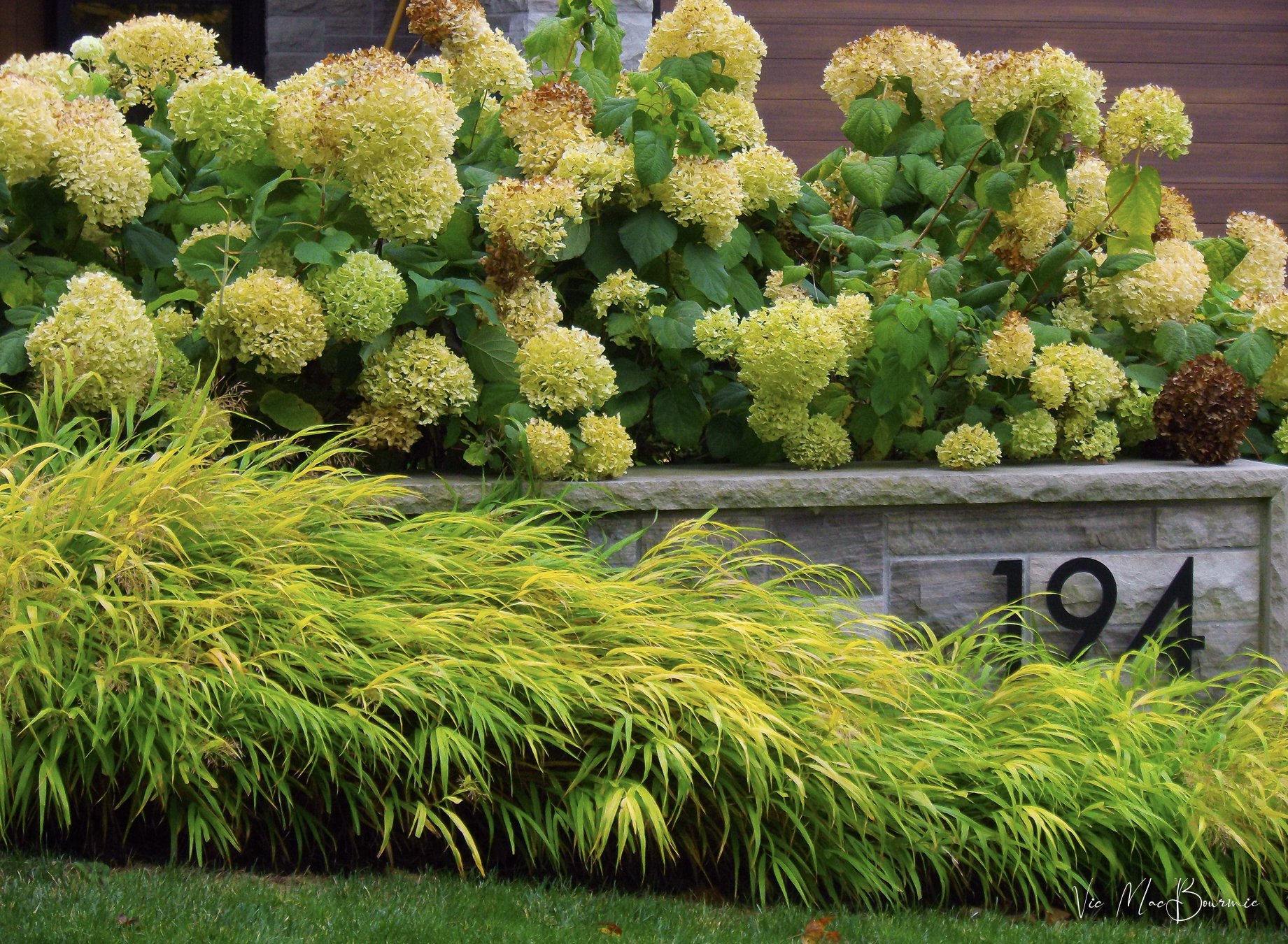
Adding a knee wall to highlight your address numbers or another desirable feature can be an effective landscape decision, but it needs to be properly executed to be effective. By keeping it simple, the garden designers here were able to add a focus to the front landscape that works, rather than adding a distraction to the existing design. Japanese Forest grass is used here to soften the hardscaping of the knee wall, while hydrangeas add further softening by cascading over the top of the cement ledge. The image below provides a larger view of the landscape.
Hardscaping elements can form the ideal background
The image above and three below illustrate how the addition of a knee wall can become the perfect backdrop to create a focal point in the garden. Simplicity is again the key element here. Notice how the landscapers focused on just a few plants and simple colour schemes to create a cohesive look.
(For my earlier post on using knee walls in the landscape click here.)
What can we learn: You may not want to hire a stone mason to create a knee wall for your front landscape, but adding a large boulder, a rock wall or even a simple homemade wooden knee wall to hi-light your address numbers can be effective if it is done right. Remember to keep it simple both in plant selection and colour scheme. Using one of today’s inexpensive solar lights will give the feature a presence in the landscape at night.
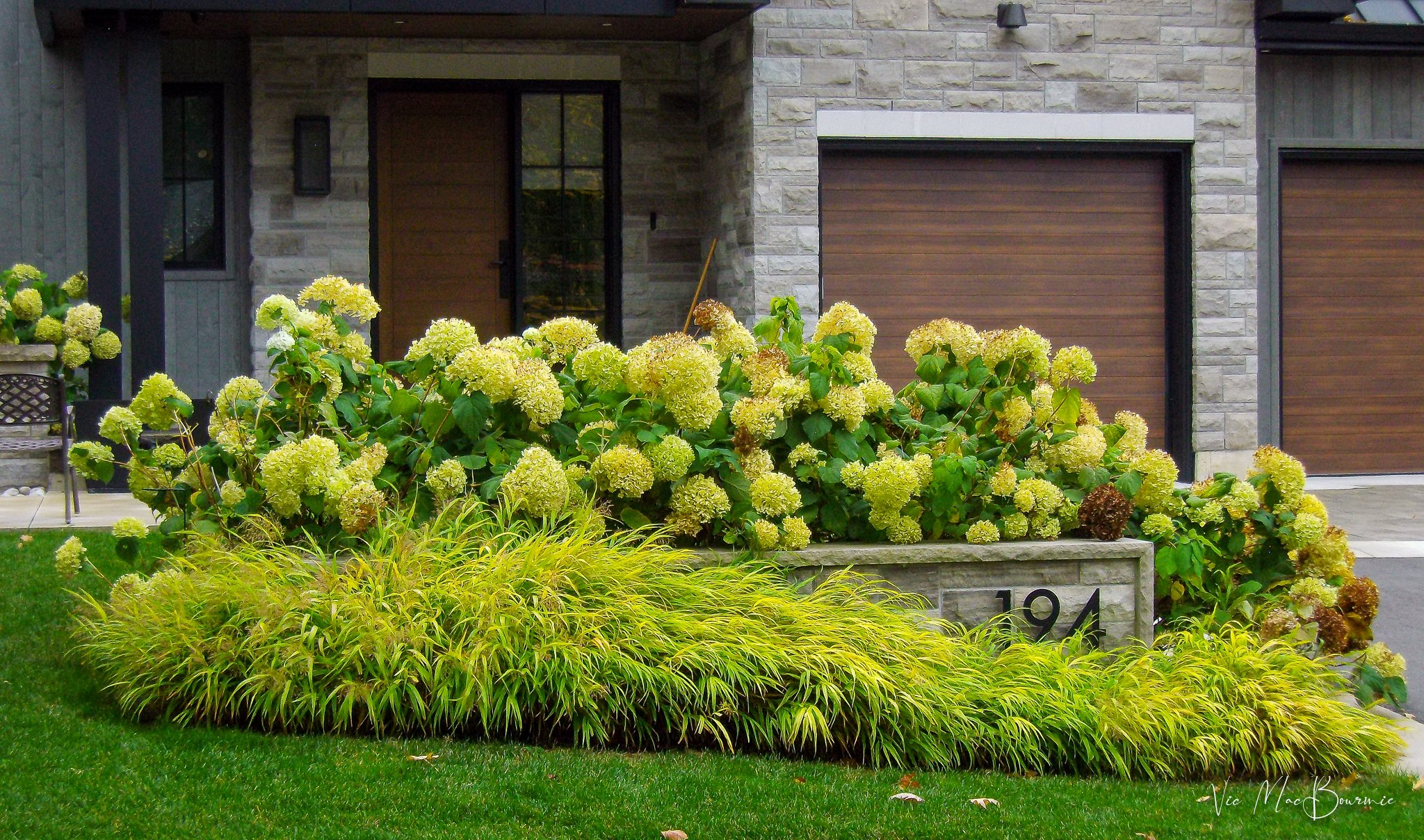
A larger view shows how the stone knee wall creates a design feature that serves a purpose but at the same time softens the landscape.
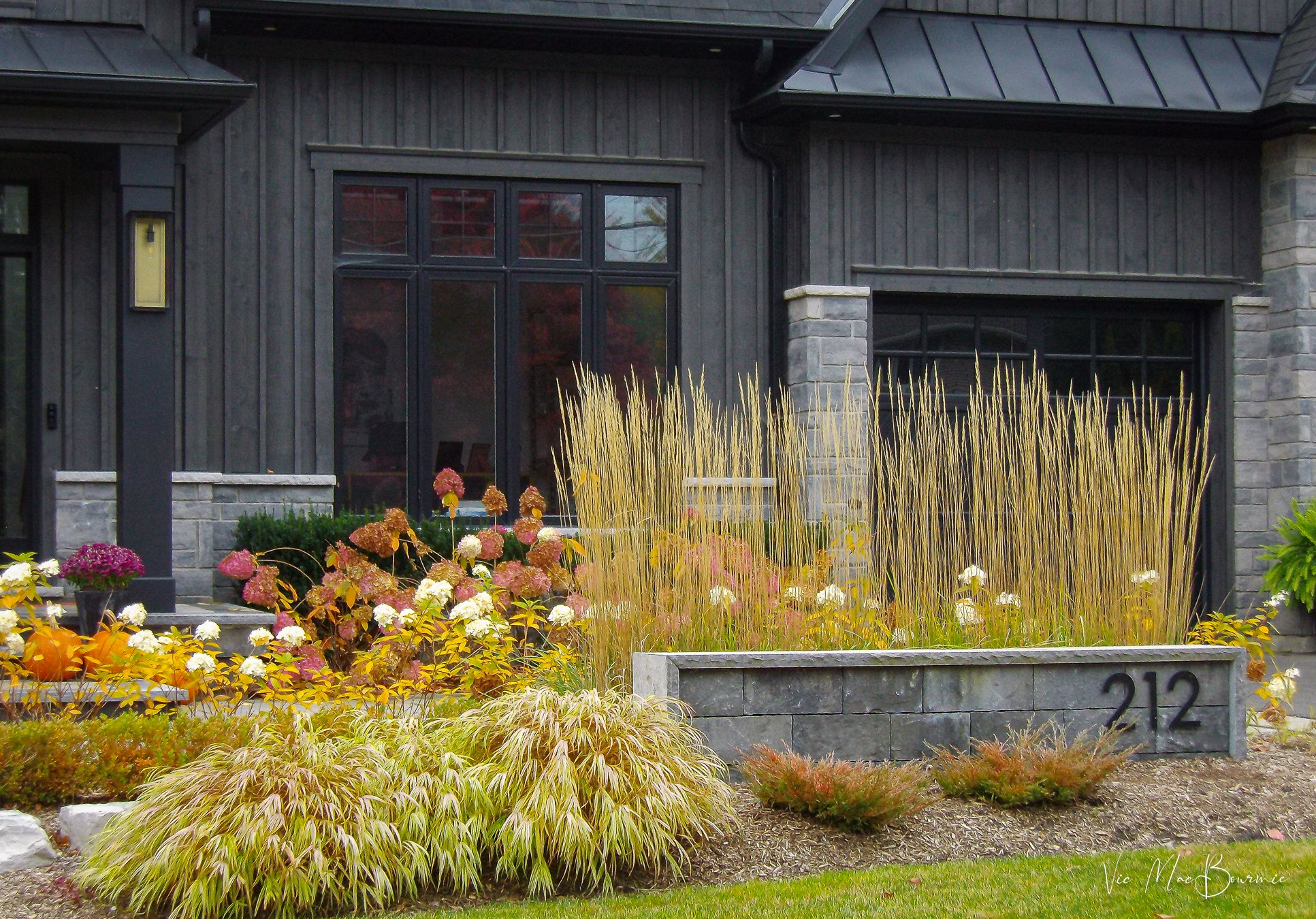
Japanese forest grass and the more upright Karl Forester grasses combine with hydrangea and junipers to give the above example both formality in the upright grasses along with a more casual approach with the softer grasses and hydrangeas. Unfortunately, none of these plants are native to this area, but simple substitutions such as little bluestem grasses and oak leaf hydrangeas could be used instead to make it more valuable to wildlife.
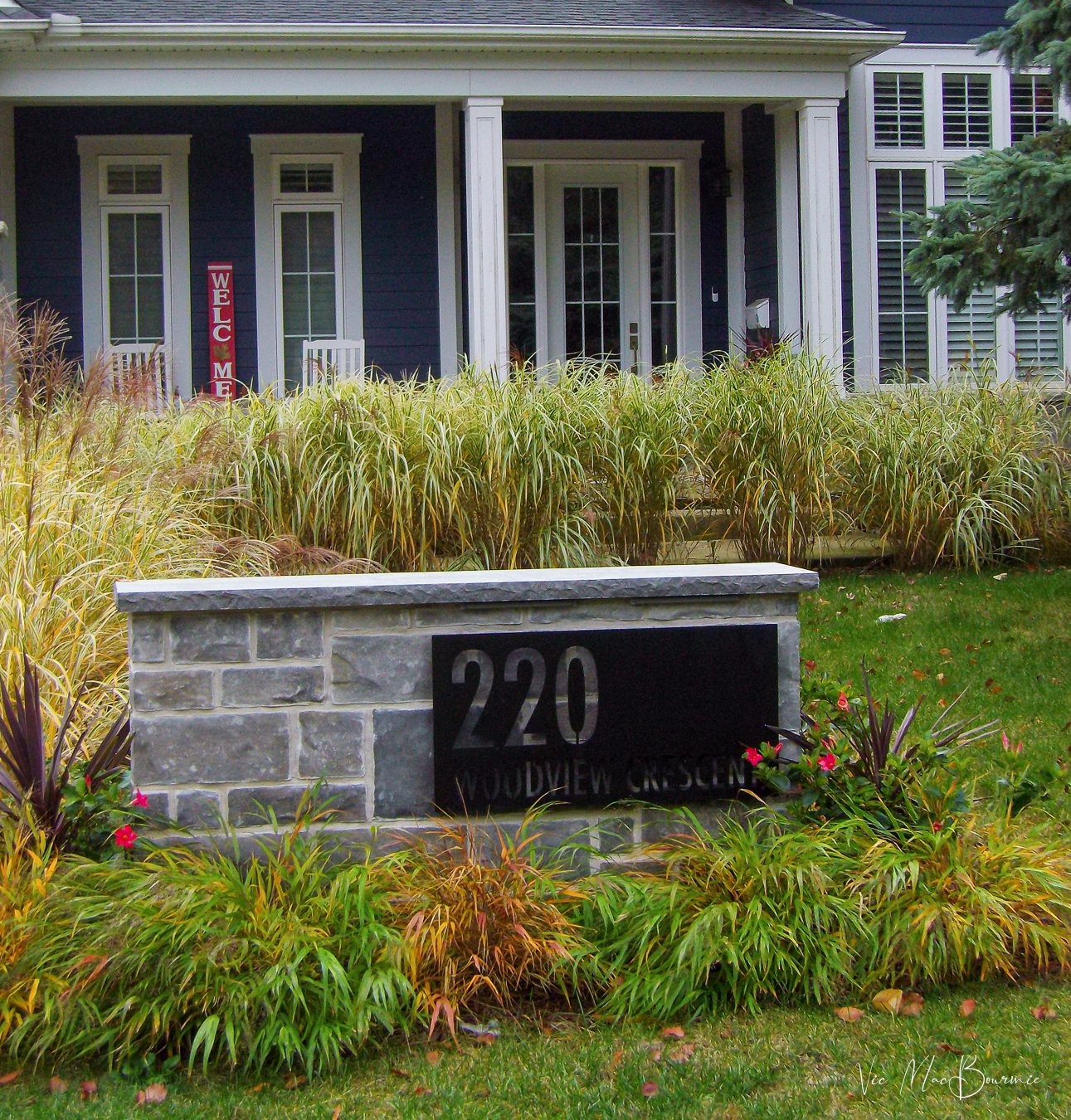
Another example of a smaller knee wall surrounded by grasses and a hint of colour with the red flowers to add a little more interest.
Substitute native planting whenever possible
Walking the neighbourhood certainly reminds me that not enough homeowners are choosing native plants. I suspect a lot of these decisions are made by professional landscape companies who are looking for impact more than worried about using native plants. That does not mean,however, that we can’t take their ideas and substitute more native plants into our designs.
By capturing images of these local landscapes, we can take the images home and spend time doing a little research into what native plants would do well in the same location.
For example, little bluestem or big bluestem can replace Karl Foerester grasses, and Northern Sea Oats would provide four-season interest rather than the more limited seasonal interest of Japanese Forest grass.
A multi-stem serviceberry or a native dogwood can take the place of the Japanese maples. Native evergreens such as hemlocks, white cedar and our elegant white pines can be used for year-round interest.
Discovering new plants and friendly gardeners
My daily walks have introduced me to many new plants that grow well in the neighbourhood.
Of course, discovering new plants you may not have been aware of, is always fun. Don’t be afraid to strike up a conversation with the gardener to get the proper names of these new plants. They may be a fount of gardening knowledge and even a source for new plants.
New ideas for older homes
If you have a more mature, older home with a landscape that has become stale, homes in the neighbourhood that have had their landscapes revived, can provide fresh ideas for your own landscape.
Here are a few examples of older homes with updated landscape designs.
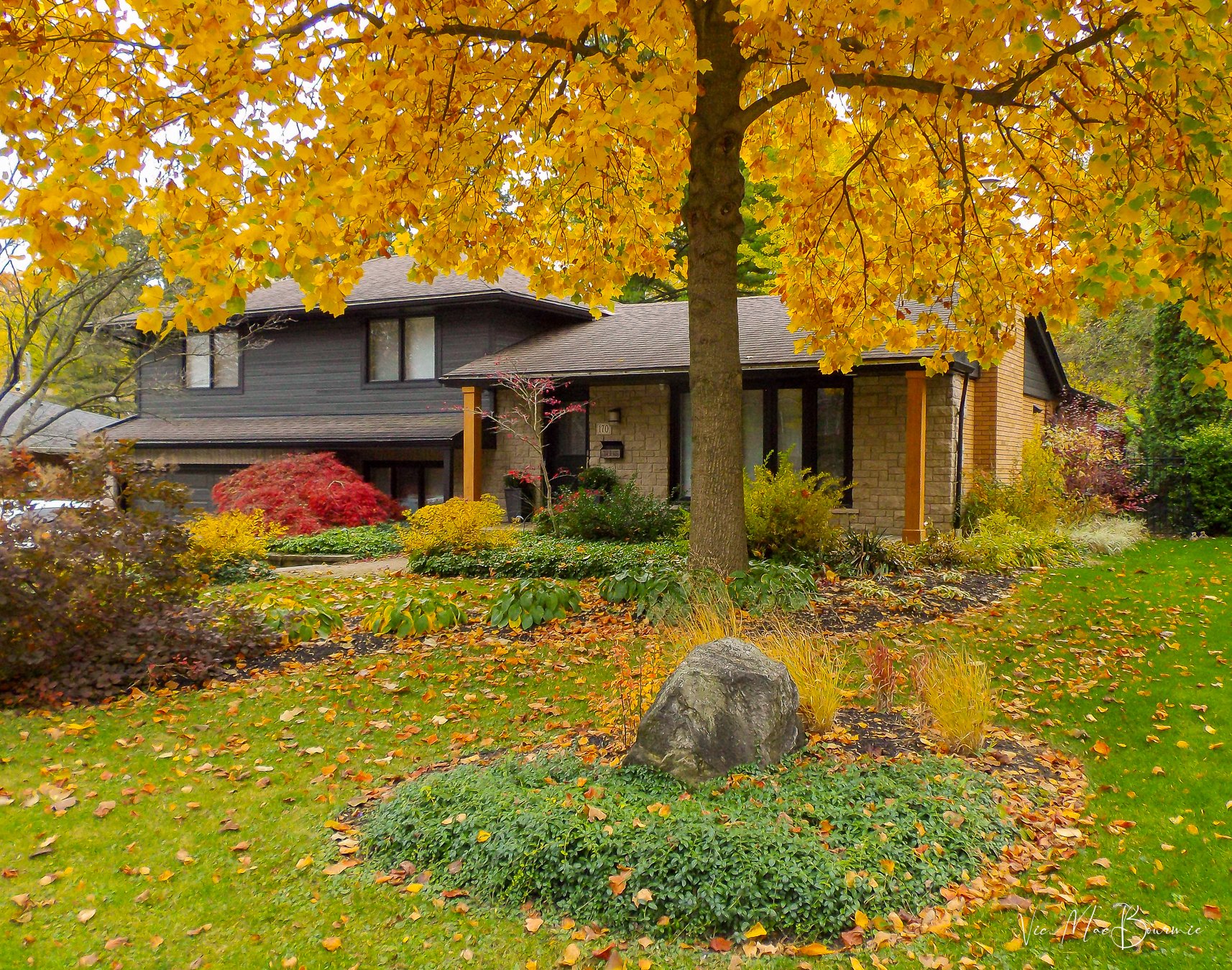
Rather than go to the trouble of having a knee wall added to your front landscape, consider adding a large boulder. A small solar light will highlight it at night and a simple planting around it will help to take your garden out away from the house closer to the street.
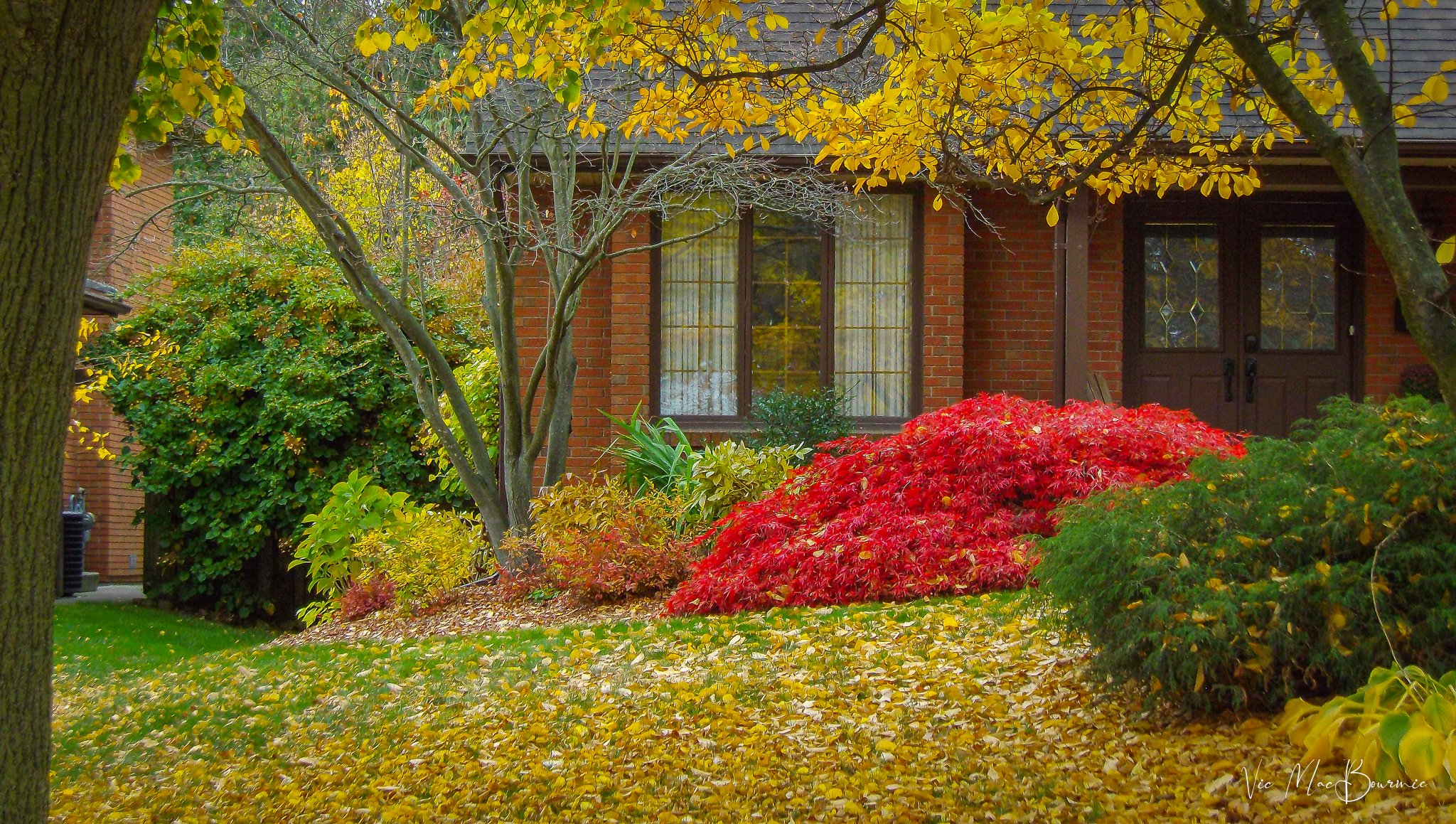
A lovely weeping Japanese Maple provides a stunning feature in the front landscape without blocking the view through the front window. Too often in a more mature landscape, evergreen bushes have grown up to block the views from inside. If you have overgrown bushes blocking your views, consider replacing them with more contemporary alternatives. The days of large yews and cedars covering the front of our homes have long past.





Simplicity in the garden adds a sense of calm and serenity to the landscape.