
Tips and ideas on how to de-skunk your dog
It all happened so fast. And it can happen to you and your dog if you are not careful. Here are some tips to deal with a skunking and ideas to help stop if from happening again.
Taking the stink out after getting skunked
It all happened so fast.
Holly and I go out every night at around 11 for her final pee. She loves it because she knows there’s a treat at the end. Maybe even two. Well, usually at least two.
It’s a quick in and out, no problem.
Not knowing what awaits us as we step outside, Holly is always on a leash and usually just a few steps in front of me until I’m sure the coast is cleared. The main back light is turned on to supplement the many solar lights and anything that is out there is given ample warning that we are coming out.
I guess no one told Pepe Le Pew the routine. The skunk was hiding behind a large rock on the edge of the patio probably busy digging for grubs. He was just steps from the back door. I think Holly was as surprised to see him as he was to see Holly. All I saw was Holly standing over the little guy before a flash of a black and white tail prompted me to yank the leash back and get her inside.
Then it hit me.

A skunk looking for food in the early evening.
Skunk spray is a form of sulfur. that is released in an oily form. The oil can stick to many surfaces and permeates everything it touches. Once released, the skunk smell fills the air and seeps into everything. It’s a good idea to close all exterior doors and open windows to keep the smell outdoors. The smell can even permeate skin and it’s not unusual to have the odour in your mouth and nose for a period of time. Is it any wonder that, if not treated properly, a dog can carry the smell for up to two years? Especially when its fur gets wet. Just ask a dog groomer. Most will not even take a dog that has been sprayed recently for fear of contaminating their grooming facility.
Holly’s smell was ripe and spreading through our small back landing. I called out for help. Paper towels please and plenty of them.
Be aware that skunks are particularly active in mid Feb. when you might not expect to come across them. This is their mating time and they are often seen during the evening but also during daylight hours roaming around even when there is significant snow on the ground. For more on their Valentine adventures, check out my post here.
Probably not a good idea to bring her inside immediately after getting skunked but I wanted to check her eyes. It’s important to check their eyes; if they're irritated or red, immediately flush them with cool water.
Her eyes seemed fine.
You know that skunk smell you get when you pass one that has been hit on the road, It was nothing like that…
Pungent. Not nice at all.
It wasn’t Holly’s first encounter with a skunk and it surely won’t be her last. After wiping her down as best as I could, we put her and her friend Monet (the cat) in the basement for the night. I felt sorry for both of them, but that’s all we could do at that time.
I would deal with her in the morning.
At first light I was up to take the little stinker outside. I expected the worst when I opened the door to the basement. I was greeted by the cat and dog together at the foot of the stairs. Not sure if Monet felt sorry for Holly or the smell wasn’t bad enough to keep these two buddies apart.
Turns out Holly was able to dodge a bullet. Either she sidestepped the worst the skunk had to offer or the skunk was still a baby and didn’t pack enough punch to make it stick.
Either way, the back entrance seemed to get the worst of it all. A complete cleaning with a Lysol cleaner and then swiffer wet, some scented candles and a diffuser running Refresh from Sage, and it’s liveable again.
Commercial de-skunking products such as Natures Miracle Skunk Odor Remover should probably be your first step to deal with the problem quickly.
Other highly rated products include: Van Den Heuvel’s R86 Industrial Odor Eliminator which is non-toxic and biodegradable. Not only does it eliminate just skunk odors, its combination of more than 30 different essential oils and natural ingredients, can eliminate several odours and is safe to use around children; Bodhi Dog Pet Deskunk Spray Odor Eliminator advertised as containing a combination of essential oils and useful on flat areas both in the home and outdoors; Skunk-off Liquid Soaker, a fast acting solution also useful on hard surfaces around the home; De-Skunk Odor Destroying Shampoo.
But being ill-prepared, I had to make a quick trip to the pet store for some de-skunking shampoo. After a good bath in her bottle cap pool, she’s almost as good as new.

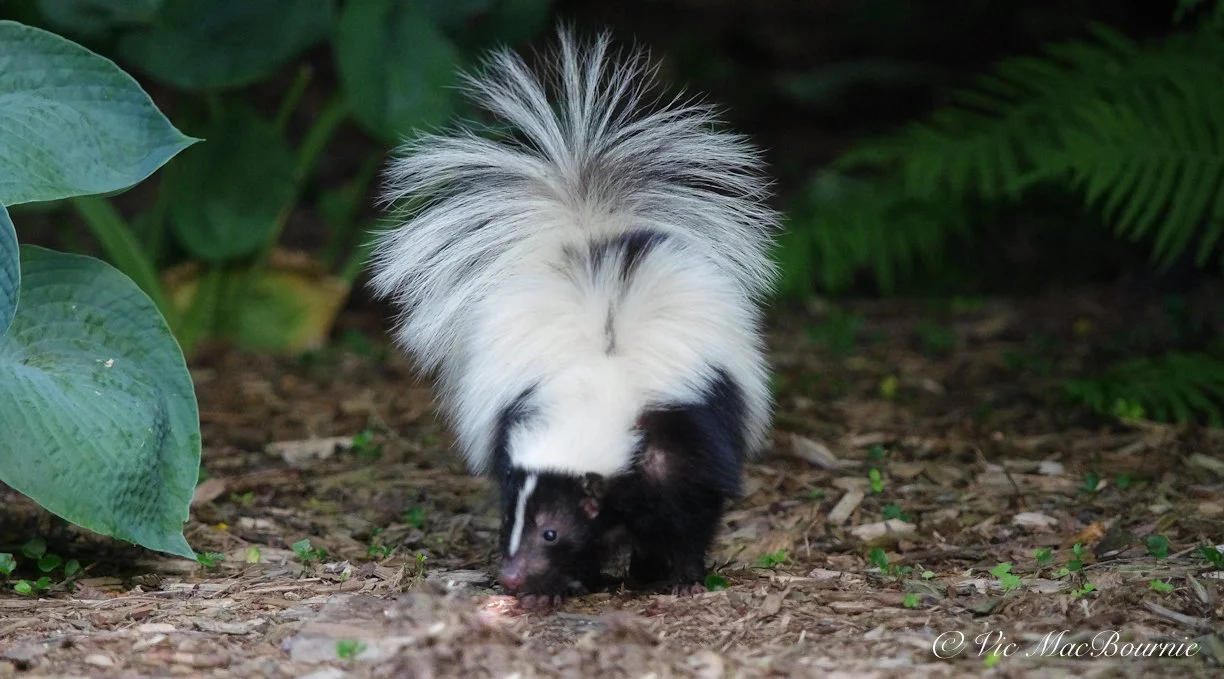
This skunk was wandering through the garden one evening showing off its beautiful tail.
Lessons learned from dog getting skunked
First lesson: Be extremely careful when taking your dog out at night. A combination of solar lights and the back light is good, but it’s not enough in a garden where skunks can be hiding behind plants, rocks or containers. Skunks don’t run fast, so give them time to clear the area. Maybe include a powerful flashlight at the back door for a pre-surveillance before going outdoors with the dog.
Second lesson: Be prepared. There’s not much you can do at 11 pm to deal with the situation if your cupboards are bare of the essentials to de-skunk your dog, or yourself, for that matter. Get some supplies (commercial de-skunkers, old towels, distilled water, rubber gloves, a face mask), put them in a box and have them ready for the big night so the skunking repercussions can, at least, be minimized.
Third lesson: Keep the area around the back door relatively open to lessen the chance of surprising the stinky ones. Always take your dog out on a leash. Despite the leash, she still got skunked. I can’t imagine letting her out on her own. Maybe yanking her back when I saw what was happening was enough to keep the damage to a minimum.
There are several commercial de-skunking remedies available that are simple to use and provide some immediate relief from the odour.
A common DIY concoction comes highly recommended by the humane society
Mix together:
1 quart of 3-per cent hydrogen peroxide (available at most pharmacies)
1/4 cup baking soda
1 teaspoon liquid dishwashing soap preferably Dawn ( highly recommended by wildlife rescues.)
The hydrogen peroxide strips the skunk’s oil from your pet’s coat, and the baking soda helps to neutralizes the smell. Keep the formula away from your pet’s eyes, mouth, ears and nose and do not let your dog swallow any (it will cause immediately vomiting.)
Pop on some rubber gloves and wash your dog with this solution as soon as possible after they’ve been sprayed.
This DIY mixture CANNOT be stored for later use. The components in this mixture could explode if left in the bottle.
Clean and Rinse: Rub the mixture through the dog’s fur, but don’t leave it on too long (peroxide can bleach fur). Rinse thoroughly.
Shampoo: Next, wash your dog with pet shampoo preferably a de-skunk shampoo and rinse thoroughly. Towel-dry the dog and leave it in a warm dry area. Now is not the time to leave it out in the cold or in a cold garage unless there is a bed and a heater nearby. By now, the smell will be either completely gone or, at best, just slightly stinky.
Wash towels and human clothing separately in a normal wash cycle.
This page contains affiliate links. If you purchase a product through one of them, I will receive a commission (at no additional cost to you) I try to only endorse products I have either used, have complete confidence in, or have experience with the manufacturer. Thank you for your support. This blog would not be possible without your continued support.
Backyard or Garden: Putting it all together
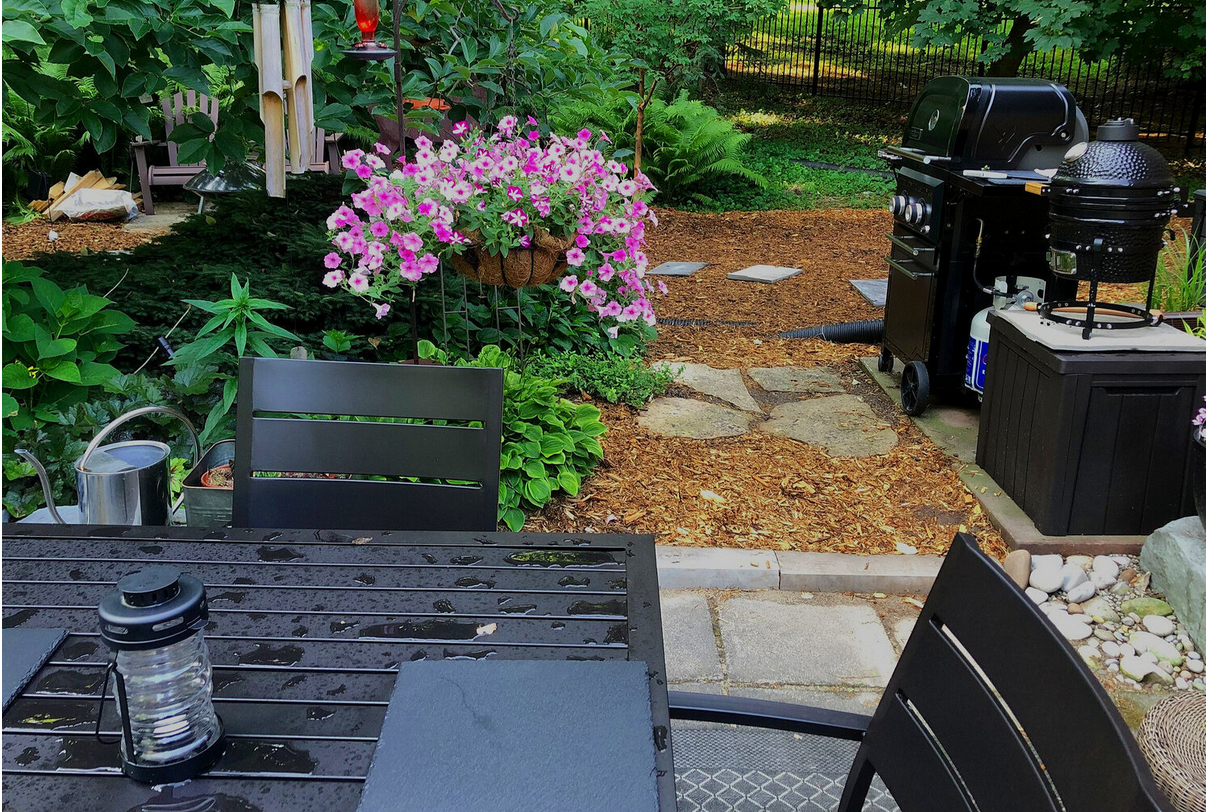
Creating outdoor living and entertaining with a backyard woodland garden begins with proper planning, but the results can be a truly enjoyable, private space that encourages outdoor living and a truly enjoyable experience.
Open Garden Tours are an opportunity to experience beautiful gardens
I love Open Garden Tours.
They provide us with an opportunity to peek behind the back gates of some of the finest gardens in our area.
They inspire us to make our gardens better, to explore new approaches and to contemplate what we think makes a garden exceptional.
Over the years, garden tours have provided me with endless inspiration. I particularly enjoy touring gardens designed and created by homeowners rather than landscape professionals, but some of the most remarkable gardens I have experienced were created by professional landscapers.
During a tour a few years ago, I remember visiting many exceptional gardens of multi-million dollar homes. Most were created and maintained by high-end professional landscape companies.
One in particular stood out – not because of what it was, but what it could have been.
Everyone who walked through the home’s swanky front gates were excited to see what awaited us as we strolled into the back of the magnificent property.
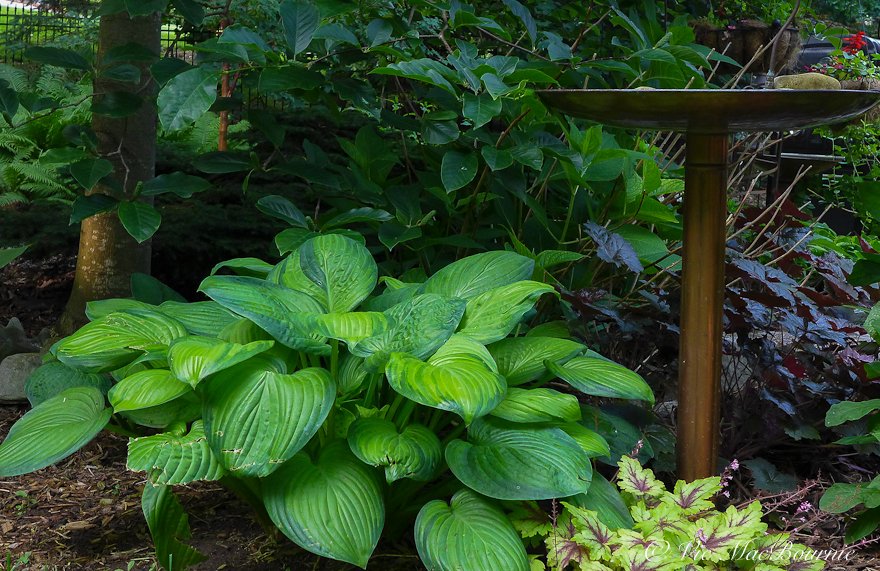
Garden tours offer the perfect excuse to go exploring in other people’s gardens.
No-one expected the disappointment that greeted us - a sea of concrete, a large pool and a small cantilevered deck overlooking a woodland. That was it. I don’t recall even a single container planted up on the stairs leading to the pool.
The owners were obviously proud of their yard. They stood outside greeting visitors who offered polite praise of the back yard pool before scampering out as quickly as possible. It didn’t help that, for comparison, most of us had just toured some of the finest gardens in the area, but it was impossible to overlook the fact that this could hardly be described as a “garden.”
I’m sure there were visitors who were impressed with the yard.
The “gardeners,” however, were aghast.
And so, the question remains: What makes a garden exceptional?
To many – these homeowners included – a backyard is a place to entertain friends and family. To others, a garden is a quiet retreat under a canopy of magnificent trees.
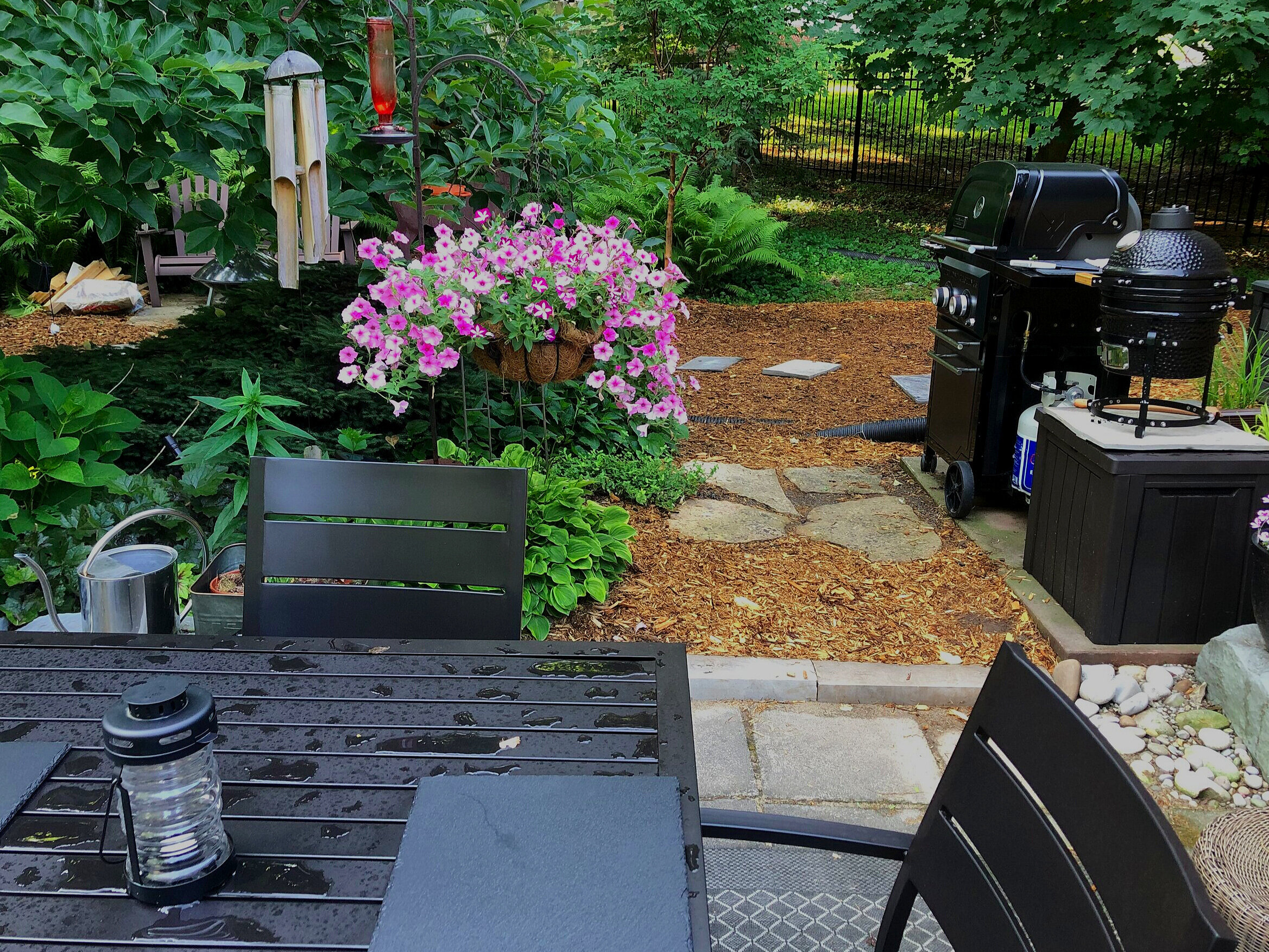
Creating entertaining areas in the garden is the perfect way to encourage everyone to spend more time enjoying the fruits of your labour.
You may have noticed that I referred to one as a “backyard” and the other as a “garden.”
Today, as urban backyards become increasingly smaller, gardens are being replaced by yards. Large decks, patios, massive outdoor kitchens, television screens and hot tubs are competing with perennial gardens, flowering trees and shrub borders for our attention.
In most cases, the plants are losing out.
Gardens are being forced out by backyard entertainment areas in many urban neighbourhoods. Obviously, this is not a good thing. Natural corridors through neighbourhoods, so vital to mammals, birds and reptiles, are shrinking. In many new neighbourhoods we are left with mini-islands of green space not large enough to sustain any meaningful life for native fauna.
It doesn’t have to be that way. With proper planning we can have it all – a place to entertain family and friends as well as natural areas in the garden for wildlife.
Let me be bold enough to make a suggestion to new homeowners: Begin with trees, not the latest high-end BBQ.
The greatest investment you can make in your yard is a small tree that will grow into a magnificent specimen, providing privacy, shade and beauty year round. For the price of a high-end BBQ, you could purchase enough young trees, shrubs and plants to set the foundation for a lovely garden that will increase your property value ten-fold in a few short years – just about the time when you’ll have to replace that BBQ with a new model.
Unlike consumer products, trees get better with age.
I’m not saying don’t buy a BBQ, build a deck, add an overhead structure or lay a new patio. I’m just suggesting you start with a garden plan whether you draw it up yourself or sit down with a professional landscaper.
Once the bones of your garden are in place, then it’s time to look at possible entertainment areas in your yard.
Surrounding these entertainment areas with gardens provides the privacy that is so sought after in many of today’s modern subdivisions. One tree may be all you will need.
Creating the garden and privacy first will surely entice you to want to spend more time outside. Even if you think a garden is not your thing, I guarantee you the experience of eating under the limbs of a tree, it’s branches festooned with outdoor lights, will go a long way to change your mind about the need for a garden.
My wife and I recently bought into this idea big time. Given the stay-at-home world that Covid brought with it, we decided it was a good idea to invest in a little outdoor luxury. We purchased not one, but two barbecues – a small, charcoal unit and a two-burner propane unit. We also added an outdoor dining table and chairs with the expectation of staying home all summer and enjoying our garden in the midst of the pandemic.
It’s already proven to be a great investment. Dining outside couldn’t be more enjoyable. French toast for breakfast on the griddle of our new Vermont Castings propane barbecue, and outstanding chicken wings from the grill of our mini Louisiana Kamado-style grill has made restaurants and take-out a thing of the past. We have a summer of new recipes ahead just waiting to sample.
Spending time outdoors couldn’t be more enjoyable. There is something very relaxing about watching nestlings take their first flights while chipmunks chase one another around your table during morning coffee.
The yard and garden coming together as one. That’s a goal we need to work toward. That just may be the recipe for happiness.